
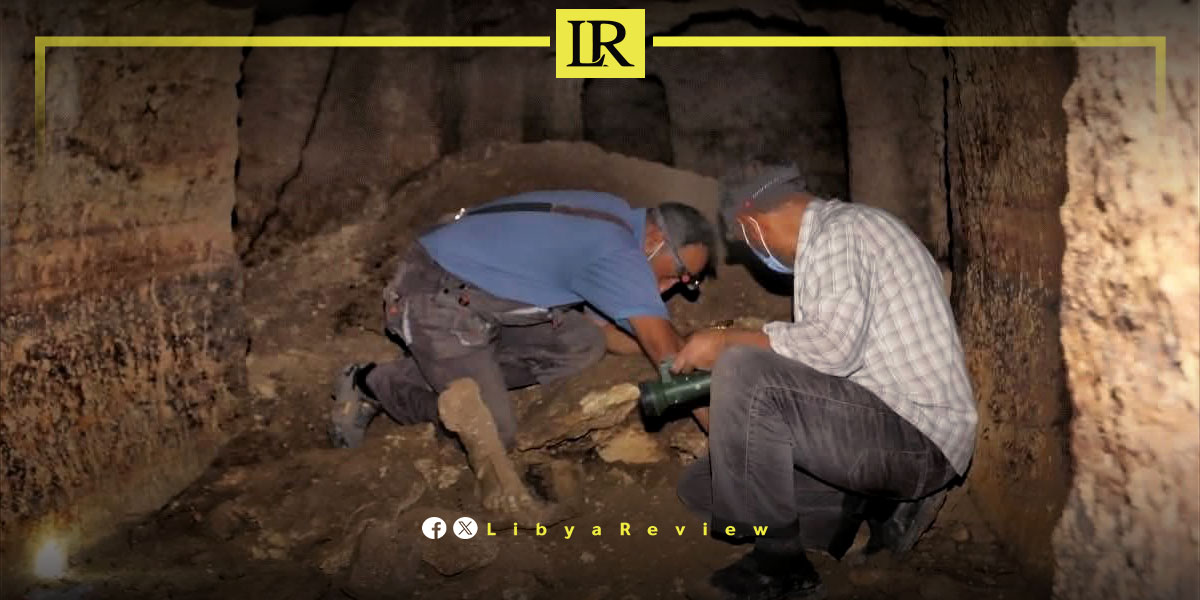
Archaeologists in Libya have announced the discovery of a previously unknown archaeological site in the ancient city of Cyrene (modern-day Shahat), believed to date back to the Hellenistic or early Roman period.
The find is being described as one of the most promising archaeological discoveries in eastern Libya in recent years.
According to the Shahat Department of Antiquities, the discovery was made by a joint research and restoration team during routine survey work in the area.
The team uncovered the remains of a circular structure connected to several underground passageways extending three to four meters below the surface.
The layout suggests that the structure may have served a ceremonial or communal purpose during antiquity.
Among the most remarkable findings were ceramic and pottery fragments, as well as a marble base featuring part of a statue depicting a human foot wearing a Greek-style sandal, a characteristic detail of Hellenistic sculpture.
Experts say these clues point to the site’s origins between the 3rd and 1st centuries BCE, a period when Cyrene was a thriving center of Greek culture and later integrated into the expanding Roman world.
The Department of Antiquities confirmed that these are preliminary results, and detailed excavation and analysis will continue to determine the site’s exact function, scale, and historical significance. Further studies will also examine whether the structure was part of a larger complex linked to Cyrene’s temples, markets, or civic buildings.
Cyrene, a UNESCO World Heritage Site, was once among the most powerful Greek colonies in North Africa and a prominent hub of philosophy, trade, and art.
The city flourished for centuries, leaving behind an extraordinary concentration of temples, theaters, and statues that continue to offer insights into ancient Mediterranean civilization.
Officials from the Department of Antiquities praised the discovery as a vital step toward preserving and understanding Libya’s archaeological heritage, noting that such findings not only enrich historical research but also strengthen prospects for future cultural tourism and restoration efforts in the region.

