
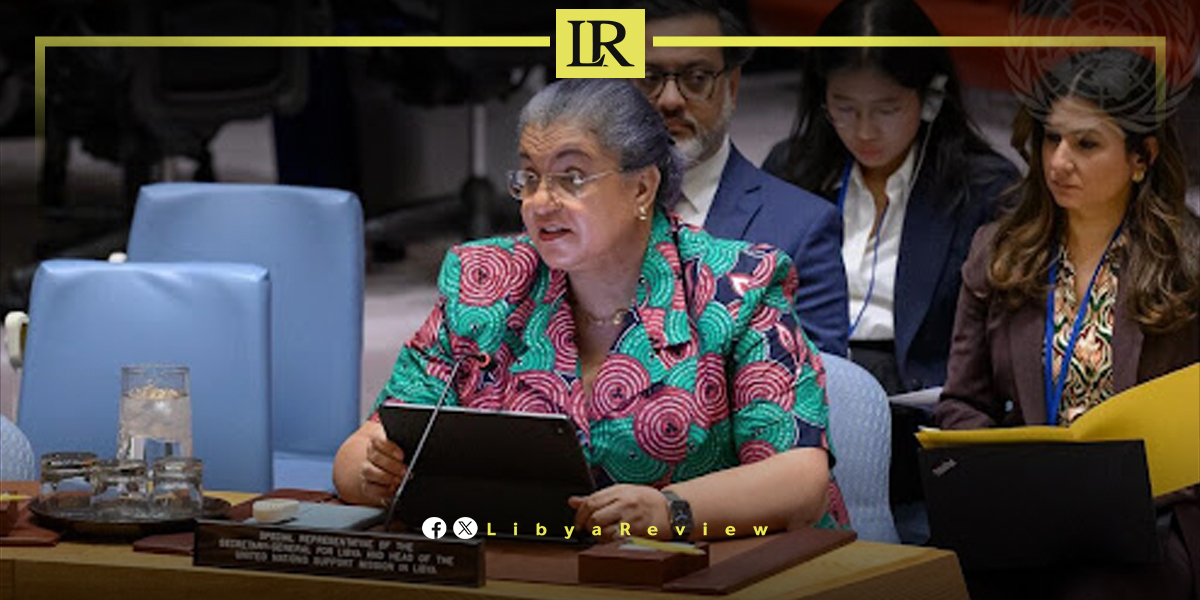
The United Nations Support Mission in Libya (UNSMIL) has once again raised the possibility of introducing an “alternative mechanism” to advance the political process if Libya’s House of Representatives and High Council of State fail to reach an agreement.
Rather than signaling a breakthrough, the proposal has revived long-standing concerns about whether the UN is addressing the root causes of Libya’s crisis or merely managing it through shifting political tracks.
The announcement that such an alternative could be presented to the UN Security Council reflects a familiar pattern in the UN’s Libya strategy.
When one pathway stalls, attention shifts to another without a serious reassessment of why previous efforts failed. While framed as a pragmatic response to political deadlock, the approach risks undermining already fragile legitimacy by sidelining existing institutions before exhausting available political leverage.
The mission has outlined priorities including restructuring the electoral commission and revising the constitutional and legal framework for elections. At the same time, it has acknowledged that no tangible progress has been achieved.
Responsibility for this stagnation is largely attributed to mistrust, internal divisions, and rivalry between Libyan institutions, a narrative that places the burden squarely on local actors while overlooking the limitations of international mediation tools.
Critics argue that the most concerning aspect of the UN’s language is the assertion that the political process should not be held hostage by key Libyan institutions. This framing implicitly justifies bypassing those bodies altogether, opening the door to alternative forums that lack broad national consensus and enforceable guarantees.
Libya’s recent history suggests such approaches rarely deliver results. Since 2011, successive UN-backed initiatives—from political agreements to international conferences—have been promoted as decisive moments, only to entrench divisions or reproduce them in new forms. The Skhirat Agreement deepened disputes over legitimacy, while later dialogues produced temporary authorities that prolonged the transitional phase rather than ending it.
The current emphasis on a “structured dialogue” risks repeating this cycle. Without binding commitments or mechanisms to ensure implementation, consultations may generate recommendations but fail to translate them into action.
As the UN prepares its next briefing, Libya appears less on the brink of resolution than caught in a recurring loop. The question remains whether the international approach is truly aimed at delivering a solution, or simply at sustaining the management of an unresolved crisis.

