
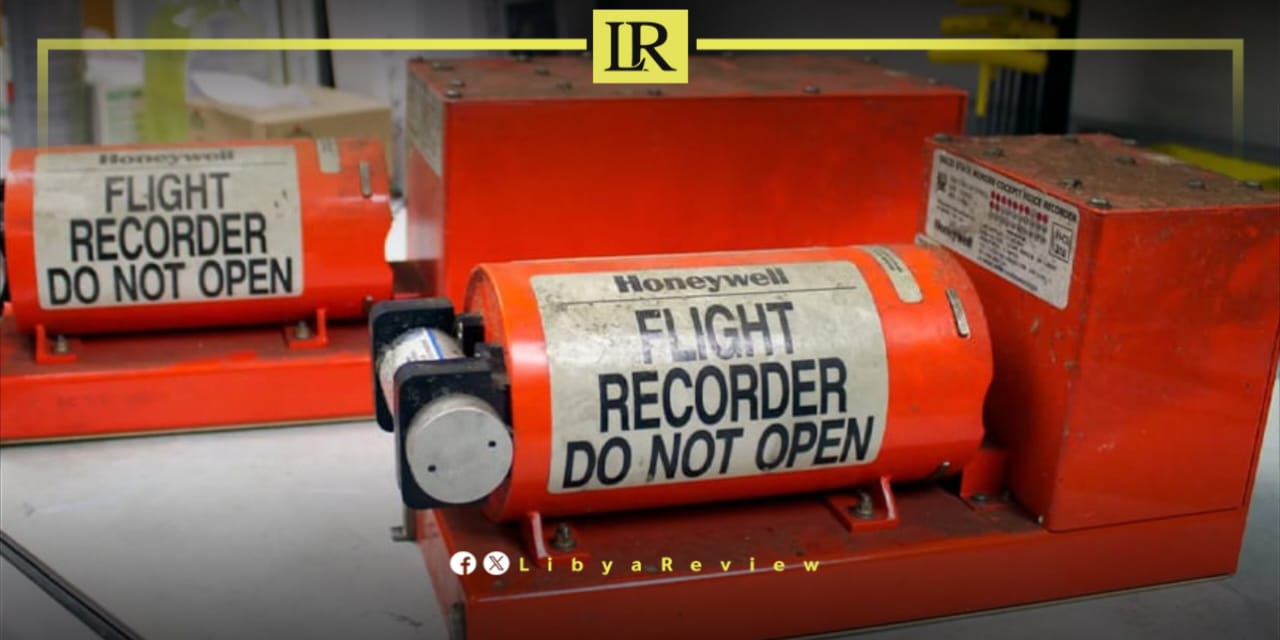
Britain has been selected as the destination to analyze the black box of the Libyan aircraft that crashed in Turkey, after Germany officially declined to carry out the technical examination.
Libya’s Ministry of Interior, citing the Turkish Investigation Committee, said Germany apologized for its inability to conduct the analysis, explaining that it lacks the technical capabilities required to handle this specific aircraft model.
According to the ministry, Libyan and Turkish authorities discussed several neutral alternatives before agreeing on the United Kingdom as the most suitable option.
The decision was taken jointly to ensure an impartial, transparent, and technically sound investigation into the causes of the crash, which claimed the lives of senior
Libyan military officials.
The ministry stated that Libyan delegations from both the Interior Ministry and the Ministry of Transport were briefed by Turkish officials on the full sequence of events, beginning with the aircraft’s arrival in Turkey and continuing through the moments leading up to its disappearance from radar.
Turkish investigators reportedly presented a detailed account of the emergency response and the steps taken immediately after contact with the aircraft was lost.
Initially, Libya and Turkey had agreed to send the black box to Germany.
Earlier statements by Turkish officials had also suggested that the recorder could be sent to a neutral country such as France. Germany’s subsequent withdrawal, however, prompted renewed consultations, resulting in the final decision to transfer the black box to Britain.
The flight data recorder, commonly referred to as the black box, is a critical component in aviation accident investigations. It records a wide range of technical data, including altitude, speed, engine performance, and flight trajectory, as well as cockpit voice recordings.
These records enable investigators to reconstruct the final moments of a flight and identify whether mechanical failure, human error, or external factors contributed to the crash.
Despite its name, the black box is painted bright orange to improve visibility among debris. It is built from highly durable materials designed to withstand extreme impact, fire, and pressure, and is typically installed in the tail section of the aircraft, where it has a higher chance of surviving a crash intact.
The aircraft was carrying Libya’s Chief of General Staff in Tripoli, Lieutenant General Mohammed Al-Haddad, along with several senior officers and aides, making the outcome of the investigation particularly significant for Libya.

