
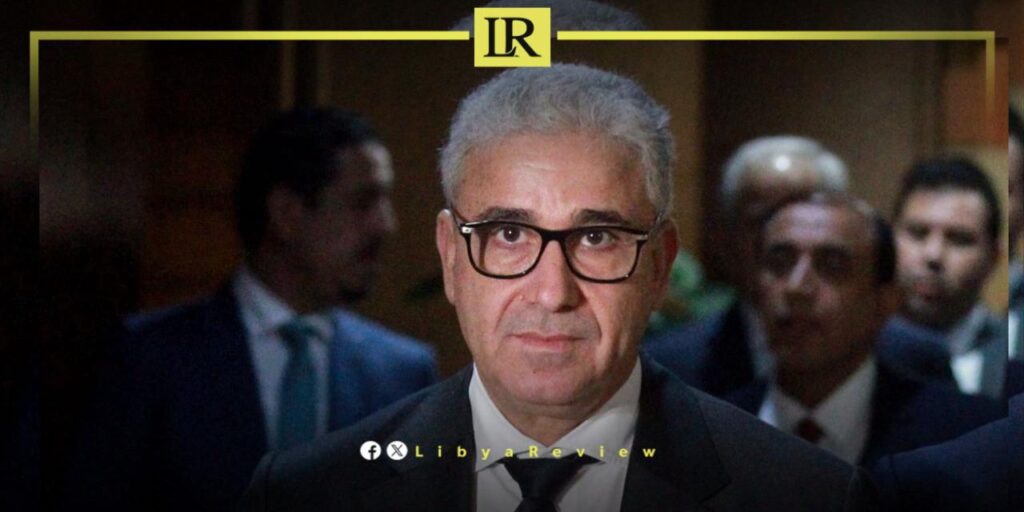
Former Libyan Prime Minister Fathi Bashagha has said that Libya’s prolonged political crisis can only be resolved through a Libyan-led dialogue, stressing that foreign-imposed solutions have consistently failed to bring lasting stability.
Speaking to Russia Today, Bashagha said Libya’s instability is deeply rooted in its modern history, beginning with Italian colonial rule and continuing through the 1969 coup, before worsening significantly after the 2011 uprising. He argued that these historical disruptions weakened state institutions and fuelled internal divisions.
Bashagha stated that any viable political settlement must be built on a Libyan–Libyan dialogue as a fundamental pillar. However, he added that internal talks alone are insufficient without credible international guarantees and regional consensus to protect agreements reached by Libyans themselves.
He noted that nearly 80% of resistance to dialogue initiatives stemmed from external factors, including competing international interests and regional rivalries. According to Bashagha, these overlapping calculations often obstructed political progress inside Libya rather than supporting it.
The former prime minister highlighted Egypt’s role as balanced and supportive of the United Nations-led political process, while describing Algeria as cautious on security matters and firmly supportive of the Libyan people. Tunisia, he said, has maintained a neutral stance and continues to coordinate with neighbouring states to promote joint efforts aimed at stability.
Bashagha stressed the importance of moving beyond past grievances and building both domestic and regional consensus. He called for the backing of a regional power with international influence to help guarantee stability and support state-building efforts.
He also underlined that the success of any political roadmap depends on the awareness and active participation of the Libyan people. Bashagha said rallying around a Libyan-led dialogue, supported internationally and regionally, remains the essential step towards overcoming divisions and building strong national institutions.
He concluded by saying that the United Nations and regional actors cannot impose a solution, insisting that genuine international commitment must focus on supporting, not replacing, a Libyan–Libyan process.

