
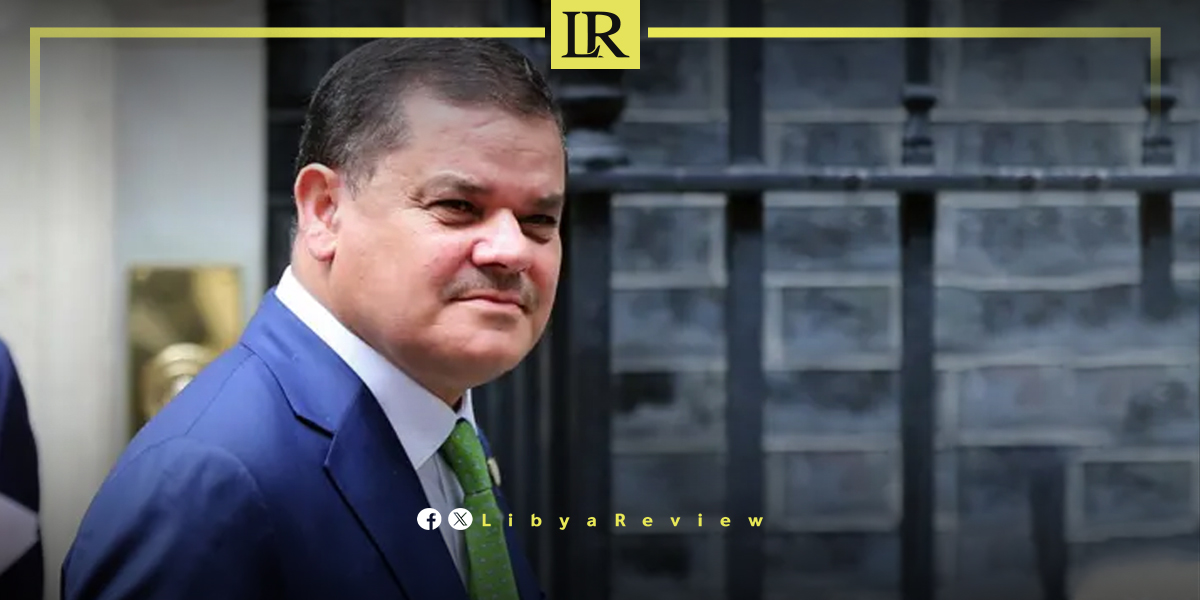
Libya’s political scene has entered a new phase of tension amid indications that Abdel-Hamid Dbaiba, head of the outgoing Government of National Unity (GNU), is attempting to reposition himself through proposals for forming a new government under his leadership in coordination with the United Nations Support Mission in Libya (UNSMIL). These manoeuvres come despite growing rejection in Tripoli and western Libya toward any continuation of his administration, which is widely criticised for years of service failures, economic stagnation, and its inability to deliver long-promised elections.
In August, the Head of UNSMIL, Hanna Serwaa Tetteh, introduced a new roadmap spanning 12 to 18 months aimed at breaking Libya’s long political deadlock and opening the way for presidential and parliamentary elections. The plan is built around three core pillars: establishing a coherent and executable electoral framework; forming a unified executive authority that merges institutions in the east and west; and launching a structured dialogue to address contentious issues, particularly in the security, economic, and electoral spheres.
Dbaiba, however, has reiterated his opposition to forming a new government or entering another transitional phase without holding direct presidential elections. He argues that flawed electoral laws remain the primary obstacle that prevented elections in 2021 and insists that going straight to elections under enforceable legislation is the only viable path to end political division and fulfil the will of Libyans.
During his recent meeting with Tetteh, Dbaiba renewed his support for her mission and its initiatives, while simultaneously clinging to his call for immediate elections. Nonetheless, the roadmap’s explicit requirement to form a unified executive authority to oversee the coming phase has strengthened impressions that the repeated contact between the two sides goes beyond technical election arrangements and may include discussions about the structure of power in the months ahead.
These political moves come at a time of growing public anger in Tripoli and across western Libya, where protest groups and citizens call not for a reshuffle but for the entire government to step down. Many residents express mounting concern over deteriorating living conditions, from delayed salaries and paralyzed banks with no cash liquidity, to soaring prices and the absence of school textbooks that left thousands of children without essential learning material.
A statement by the Souq Al-Jumaa Youth Movement, one of Tripoli’s most active community groups, reflects the depth of popular frustration. It described the situation as a “dangerous decline that can no longer be tolerated,” accusing the government of mismanagement, waste of public funds, and repeated failures across essential sectors. The group added that attempts by the government to blame others for the crisis no longer convince the public, warning that continued misgovernance will push Libyan families to the edge of hardship.
Observers note that this rising public discontent limits Dbaiba’s ability to manoeuvre politically in Tripoli, where many believe his government has lost control over critical service files. In this climate, any talks about restructuring authority or forming a new transitional government with UN involvement may be viewed as an attempt to recycle the same leadership rather than deliver genuine change.
As UN efforts to reshape Libya’s executive authority move forward, and as Dbaiba seeks to secure a place in any new political arrangement, Libyans fear the country may be steered into yet another prolonged phase of political bargaining that extends the crisis rather than resolves it. Meanwhile, calls are growing in Tripoli and surrounding areas for a complete change in the executive landscape. Many warn that any solution that does not pass through the ballot box—and does not place the interests of citizens at the centre of the political process—will amount to nothing more than a renewed cycle of the same crisis that has exhausted Libyans for years.

