
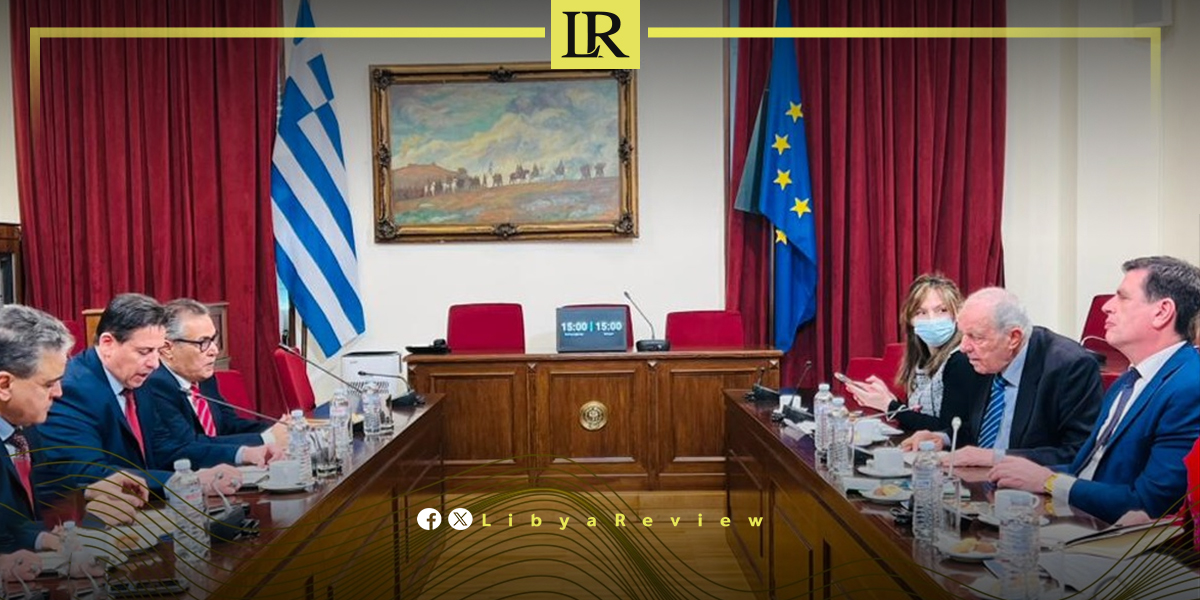
Senior lawmakers from Libya and Greece held high-level parliamentary talks in Athens on Tuesday, focusing on cooperation over Libya’s frozen sovereign assets held overseas and ways to strengthen transparency and compliance with international resolutions.
The discussions brought together the Libyan House of Representatives’ Committee for the Verification and Follow-up of Frozen Assets Abroad, led by Yusuf Al-Aqouri, with the participation of Omar Tntoush, head of the Planning, Finance and Budget Committee, and Ambassador Murad Hamima. The Libyan delegation met with Dimitris Kairidis, Chairman of the Greek Parliament’s Committee on National Defence and Foreign Affairs, at the Hellenic Parliament in the Greek capital.
Both sides reviewed mechanisms to enhance the monitoring and protection of Libya’s frozen funds, in line with relevant United Nations Security Council resolutions. The talks aimed to promote higher levels of transparency and ensure that the management of these assets serves the interests of the Libyan state and its people.
Kairidis welcomed the Libyan delegation, stressing that Greece, as an active member of the United Nations and the European Union, is keen to support all efforts that contribute to stability and prosperity in Libya. He said he would convey the outcomes of the meeting to the Greek Prime Minister, the Ministry of Foreign Affairs and other relevant institutions, reaffirming Greece’s support for Libya’s legitimate and lawful claims regarding its frozen assets.
The Greek official also highlighted the importance of parliamentary diplomacy as a direct channel of communication between nations. He expressed Athens’ desire to further develop relations with Libya and expand bilateral cooperation in key areas, including energy, infrastructure, maritime resources and efforts to combat irregular migration, as well as other issues of mutual interest.
In a separate meeting, the Libyan committee also held talks with Ioannis Plakiotakis, First Deputy Speaker of the Greek Parliament. Both sides underlined the depth of historical ties between Libya and Greece and discussed ways to enhance coordination in the coming period. They stressed that parliamentary cooperation can play a constructive role in addressing shared challenges and supporting security and stability across the region.
Plakiotakis confirmed that he would relay the Libyan position on frozen assets to the Greek Ministry of Foreign Affairs and seek Athens’ support for Libya’s case at both European and international levels.

