
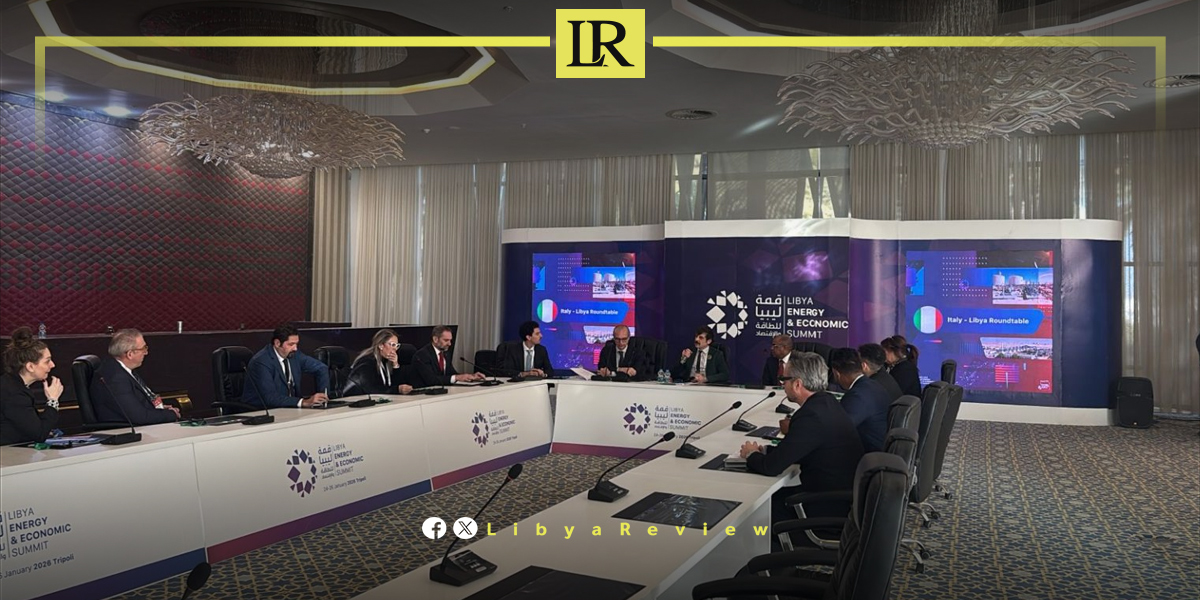
The Libya Energy and Economic Summit 2026 hosted high-level discussions on expanding Libya’s long-standing energy partnership with Italy to include electricity generation, alongside continued cooperation in oil and natural gas development.
During a roundtable held on the sidelines of the summit in Tripoli on Saturday, Libya’s Minister of Oil and Gas Khalifa Abdulsadek underlined Italy’s pivotal role in Libya’s energy sector and called on Italian companies to deepen their involvement across the full energy value chain.
He emphasized that power generation represents a strategic priority for Libya, noting that Italian technical expertise and industrial capacity could play a major role in addressing the country’s electricity needs.
Abdulsadek said Libya remains open to international business and investment, stressing that Italy has been and will continue to be one of Libya’s most important energy partners. He added that Tripoli is seeking to build a new phase in its energy future by diversifying cooperation beyond hydrocarbons to include electricity production, infrastructure development, and related services.
Italy’s Ambassador to Libya Gianluca Alberini reaffirmed that energy remains the backbone of Libyan-Italian relations, describing Libya as one of Italy’s most strategic partners in the Mediterranean. He noted that oil continues to be a cornerstone of Italy’s energy strategy, while also highlighting growing opportunities for cooperation in power generation, infrastructure, and services.
The Italian ambassador said concrete steps are being taken to strengthen bilateral economic ties, including simplifying visa procedures for Libyan business partners and improving air connectivity through direct flights between Libya and Italy. These measures, he said, are aimed at facilitating commercial exchanges and encouraging broader investment.
Libya is expected to complete several major oil and gas projects in 2026, further reinforcing its appeal to international partners. Among them is the eight-billion-dollar A&E Structures project, targeting production of 750 million cubic feet of gas per day, as well as the offshore Bouri gas project, where Saipem is executing a one-billion-dollar contract to reduce gas flaring and boost export capacity.
The roundtable was also attended by Italian industrial groups and energy service providers already active in Libya or seeking to expand operations, underscoring growing momentum toward deeper Libyan-Italian cooperation in both energy production and power generation.

