
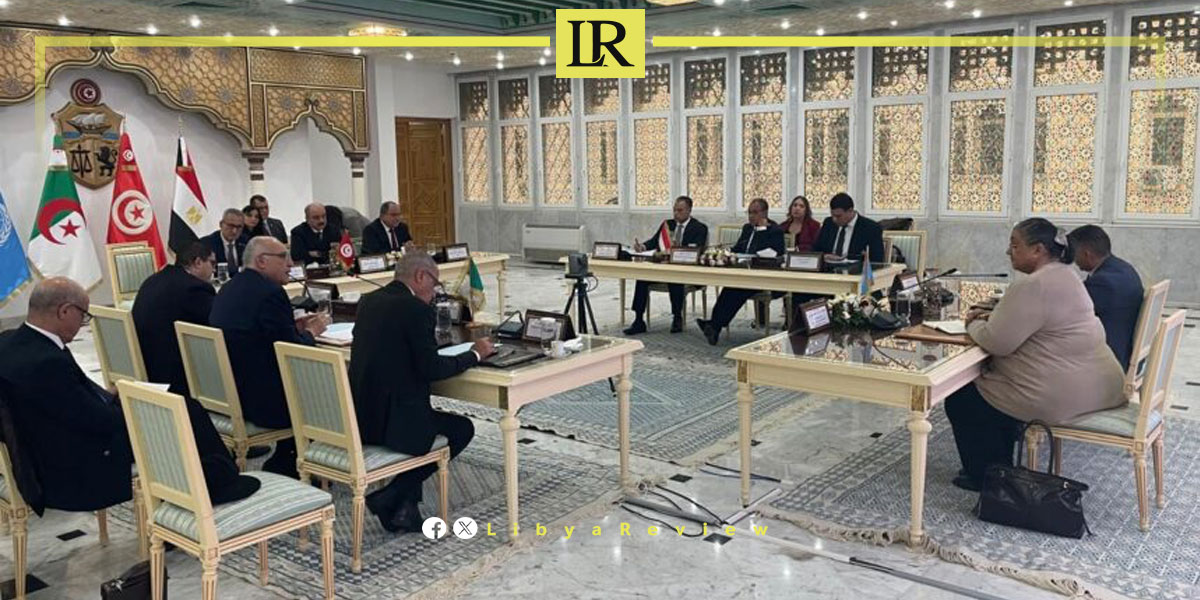
The foreign ministers of Egypt, Tunisia, and Algeria on Monday called for a clearly defined and time-bound political plan under United Nations supervision to resolve Libya’s prolonged political crisis and end years of institutional fragmentation.
In a final communiqué of the Tripartite Mechanism meeting, the ministers reaffirmed that a comprehensive political settlement remains the only path toward national unity, stable governance, and the holding of simultaneous presidential and parliamentary elections.
The ministerial meeting was held in Tunis and was attended by Egyptian Foreign Minister Badr Abdelatty, Tunisian Foreign Minister Mohamed Ali Nafti, and Algerian Foreign Minister Ahmed Attaf, with the participation of the UN Special Representative for Libya, Hanna Serwaa Tetteh.
The statement emphasized that Libya’s national interest and the aspirations of its people for security, sovereignty, and stability must remain the guiding principles of all regional and international efforts.
The ministers stressed that the political process must be entirely Libyan-led and Libyan-owned, rejecting any form of external interference.
They underlined the necessity of withdrawing foreign fighters and mercenaries from Libyan territory, arguing that their continued presence undermines sovereignty and complicates prospects for peace. The communiqué also called on Libyan political actors to engage in inclusive dialogue without exclusion, urging them to overcome divisions and move toward unifying state institutions, including military and security bodies.
Participants reaffirmed support for the Joint Military Commission as a cornerstone of stability and confidence-building, while highlighting the importance of maintaining Libya’s neutrality amid regional and international rivalries. They emphasized that insulating Libya from external polarization would allow Libyans to shape their future without pressure or imposed solutions.
The meeting also stressed the urgency of creating the political, legal, and security conditions necessary for holding nationwide elections, viewing them as essential to ending the transitional phase and restoring legitimacy to state institutions.
The ministers noted that economic integration among Libya’s regions could play a vital role in supporting reconciliation and fostering sustainable development.
The final statement affirmed that Libya’s stability is inseparable from Arab national security and from stability in the Sahel and Sahara regions, calling for enhanced regional coordination to address shared risks and threats.
The ministers agreed to continue regular consultations within the Tripartite Mechanism framework, welcomed Tunisia’s readiness to host broader Libyan dialogue meetings, and confirmed that the next ministerial session will be held in Cairo at a date to be agreed through diplomatic channels.

