
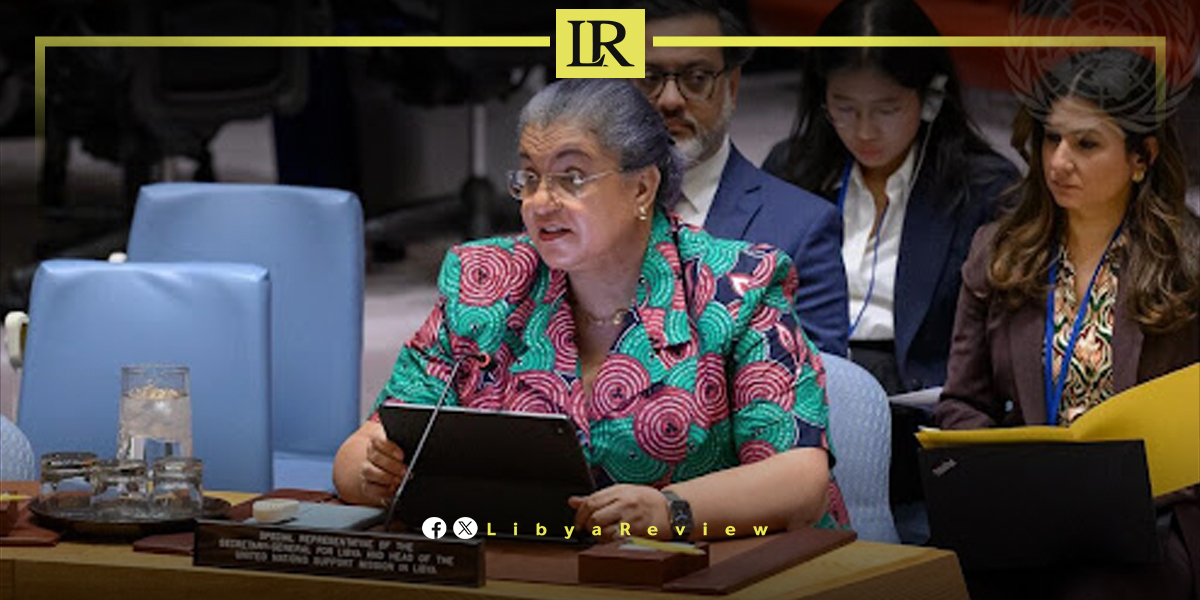
The head of the United Nations Support Mission in Libya (UNSMIL) warned the UN Security Council that Libya’s prolonged political deadlock is threatening the country’s unity, weakening state institutions, and worsening economic and security conditions.
Briefing the Council in New York, Hanna Tetteh said that despite sustained UN engagement, Libya’s rival political bodies have failed to implement the initial steps of the agreed political roadmap. She pointed to the lack of progress between the Libyan House of Representatives and the High Council of State in establishing a mechanism to appoint a new board for the High National Elections Commission and advancing electoral legislation.
Tetteh stated that the failure to follow agreed procedures, combined with unilateral actions, has further eroded public confidence. Many Libyans, she noted, increasingly believe political institutions are either unable or unwilling to deliver credible elections.
She revealed that consultations are underway on a possible alternative two-step approach to revive the process, warning that broader political engagement may be required if consensus remains elusive.
The envoy also raised serious concerns about divisions within Libya’s judiciary. Parallel constitutional rulings issued from Benghazi and Tripoli risk undermining the unity of the legal system. She described the growing judicial split as a “red line,” cautioning that continued escalation could damage the integrity of the state.
On the economic front, Tetteh highlighted rising hardship linked to currency devaluation, inflation, and persistent fuel shortages. She said the recent devaluation of the dinar, while aimed at easing foreign currency pressures, has negatively impacted vulnerable households. With nearly 80 percent of public spending allocated to salaries and subsidies, limited resources remain for development or recovery.
She also warned of expanding transnational crime networks and serious human rights abuses linked to human trafficking.
Concluding her remarks, Tetteh stressed that only a comprehensive political solution supported by coordinated international engagement can restore unified governance and prevent further instability.

