
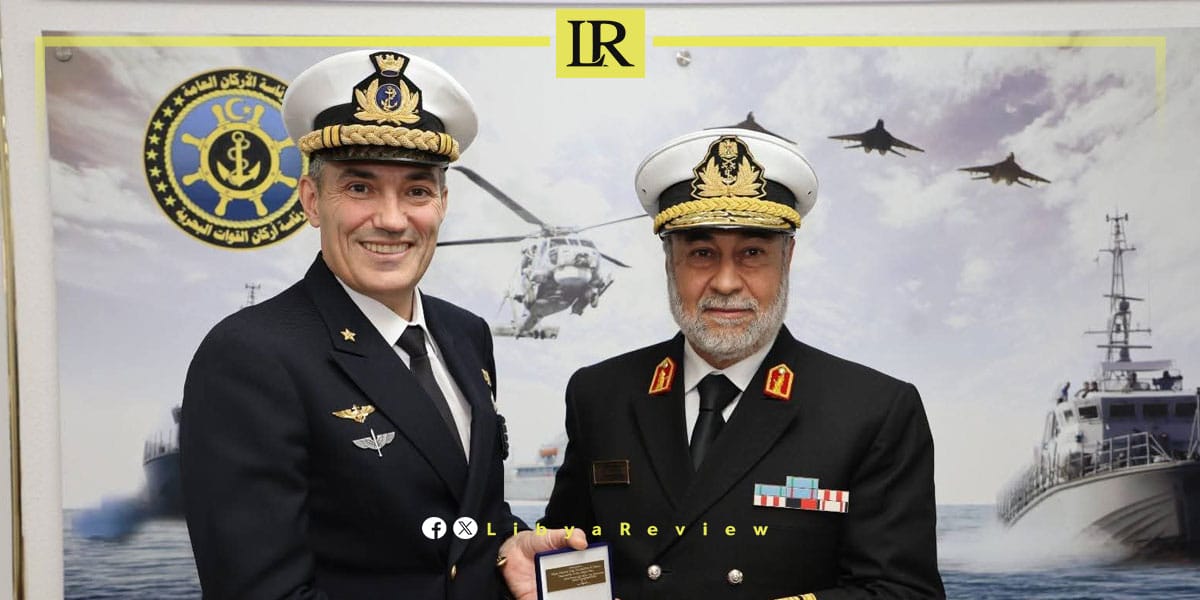
The European Union’s Operation Irini has reaffirmed its commitment to continuing the training and capacity-building of the Libyan Coast Guard, amid renewed international focus on migration and maritime security in the central Mediterranean.
In an official statement, the mission said its efforts remain focused on enhancing Libyan capabilities through technical cooperation, institutional coordination and specialised training programmes. The announcement followed a recent visit to Tripoli by the mission’s commander, Marco Casabierri, who held a series of high-level meetings with Libyan military and civilian officials.
During the visit, Casabierri met the Chief of the General Staff appointed by the Presidential Council, Lieutenant General Salah Al-Namroush, alongside senior naval commanders, Libyan Coast Guard officials affiliated with the Government of National Unity, and representatives from the foreign ministry. According to Italy’s Agenzia Nova, the discussions centred on strengthening cooperation and improving institutional coordination between Libya and the European Union.
The agency described the visit as a “key step” towards reinforcing partnership in the central Mediterranean, particularly as migration remains a top priority for European governments. Talks reportedly focused on expanding joint efforts and improving operational alignment in maritime surveillance and rescue operations.
As part of the programme, Casabierri also visited the Maritime Rescue Coordination Centre in Tripoli, which is funded by the European Union. The centre is considered a central operational tool through which Brussels supports Libya’s search and rescue capabilities.
However, Nova noted that the coordination centre remains politically sensitive, as the management of rescue and interception operations continues to draw scrutiny from human rights organisations and remains a subject of debate between EU institutions and Libyan authorities.
In January, Operation Irini intensified its monitoring activities in the central Mediterranean, detecting 65 additional suspicious flights and conducting more than 300 new radio contacts with commercial vessels, underscoring the mission’s expanding surveillance role.

