
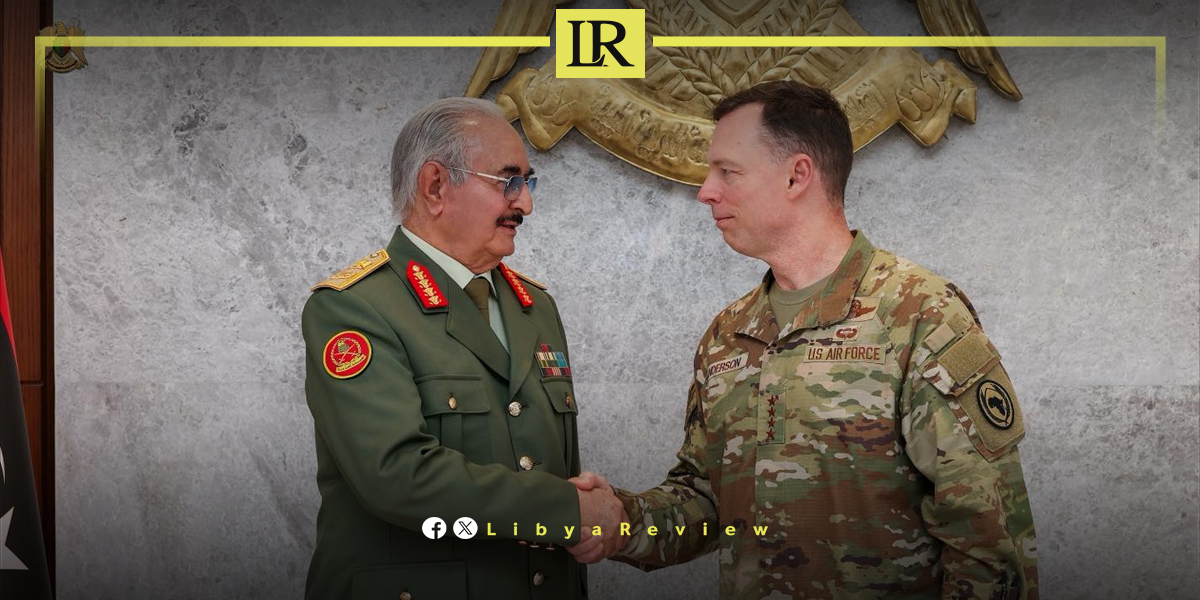
Field Marshal Khalifa Haftar, General Commander of the Libyan National Army (LNa), held high-level talks in Benghazi with US Africa Command (AFRICOM) Commander Lt. Gen. Dagvin Anderson, focusing on expanding military cooperation and strengthening joint efforts to counter terrorism, human trafficking networks, and irregular migration across Libya’s borders.
The meeting took place at the General Command headquarters in Rajma and included the presence of senior LNA officials, among them Deputy Commander Lt. Gen. Saddam Khalifa Haftar and Chief of General Staff Lt. Gen. Khaled Khalifa Haftar.
The US delegation also included the Chargé d’Affaires of the U.S. Embassy in Libya, Jeremy Brent.
Discussions centered on the development of joint training programs aimed at enhancing the operational capabilities of LNA forces and increasing coordination on counterterrorism operations.
Both sides emphasized the need to intensify efforts against extremist groups and transnational criminal networks that continue to pose security challenges in Libya and the broader Sahel and Mediterranean region.
Haftar welcomed the U.S. delegation and underscored the importance of strengthening strategic cooperation between Libya and the United States, describing the partnership as a key contributor to regional stability. He highlighted the LNA’s role in securing large areas of the country and safeguarding major population centers, stressing that enhanced cooperation could further support long-term stability.
For his part, Anderson affirmed the depth of the U.S.–Libya relationship and highlighted what he described as the LNA’s central role in combating terrorism and securing Libya’s borders. He noted that closer cooperation with the LNA would help reinforce both national and regional security.
The AFRICOM commander’s visit to Benghazi followed a series of meetings in Tripoli a day earlier, where he held talks with senior officials of the Government of National Unity. Discussions there focused on preparations for the Flintlock 2026 exercises scheduled to take place in Sirte, as well as ongoing efforts to unify Libya’s fragmented military institutions and expand cooperation in military training, intelligence coordination, and operational planning.

