
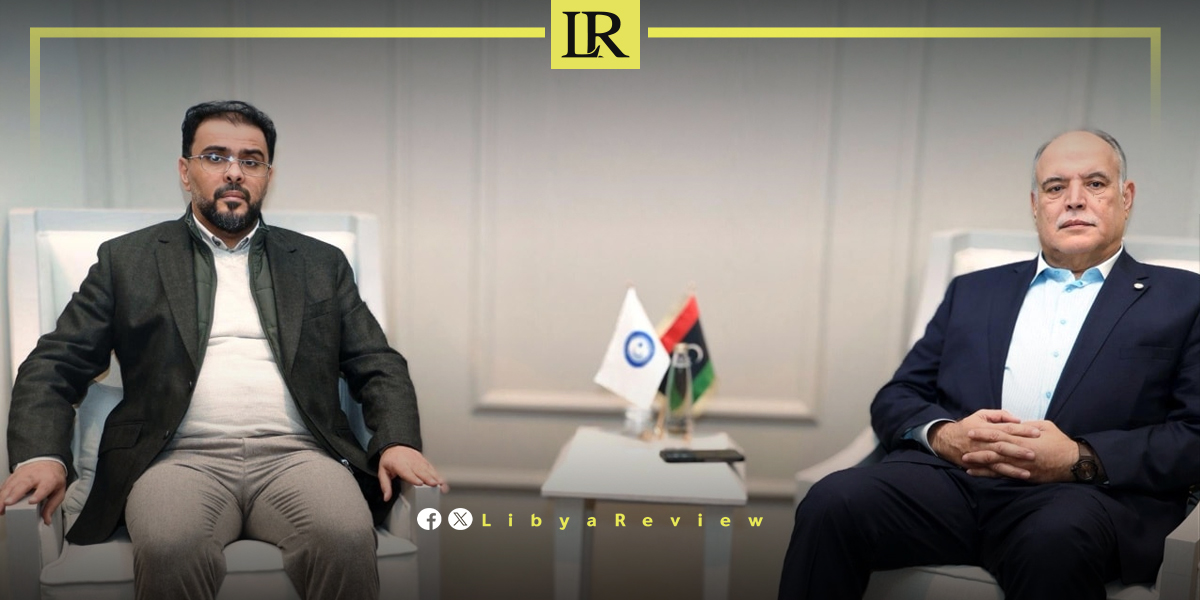
Libya’s Prime Minister of the Parliament-designate government, Osama Hammad, met on Monday with Libya’s National Security Adviser, Ibrahim Abu Shnaf, to review the current conditions of prisons across the country and discuss steps to strengthen oversight, protect detainees’ rights, and improve institutional performance.
The meeting, held at the Prime Minister’s Office, focused on the committee’s mandate and operational framework as outlined in the decision establishing it. Both sides discussed the overall situation inside detention facilities, existing challenges, and practical measures to improve prison conditions in line with Libyan law and international standards.
Particular attention was given to ensuring respect for prisoners’ rights, enhancing healthcare and social services, and preventing any cases of detention outside legal frameworks.
For his part, Prime Minister Hammad stressed that the government places a high priority on reforming the prison system as part of broader efforts to reinforce justice, uphold human dignity, and strengthen the rule of law throughout Libya. He reaffirmed the government’s full support for the committee’s work and pledged to provide the necessary backing to enable it to carry out its duties effectively.
The head of the National Interim Committee for Monitoring Prisoners and Detention Facilities emphasized the importance of close and continuous coordination between the monitoring committee and judicial, security, and health institutions, noting that cooperation among these bodies is essential to addressing violations, resolving legal irregularities, and ensuring accountability.
He also underlined the need to prevent any unlawful detention practices and to ensure that all detention facilities operate within clearly defined legal and institutional frameworks.
Abu Shnaf presented an initial briefing on the committee’s activities since its formation. He outlined the first steps taken to launch its work and shared an overview of the action plan for the coming phase, which includes field assessments, data collection, and coordination with relevant authorities.
He also noted that the committee aims to submit practical recommendations focused on improving prison management, safeguarding detainee welfare, and supporting long-term institutional reform.
The Libyan official stressed that the committee’s work is guided by legal standards and humanitarian principles, and that addressing systemic shortcomings in detention facilities will require sustained political support and cooperation across state institutions.

