
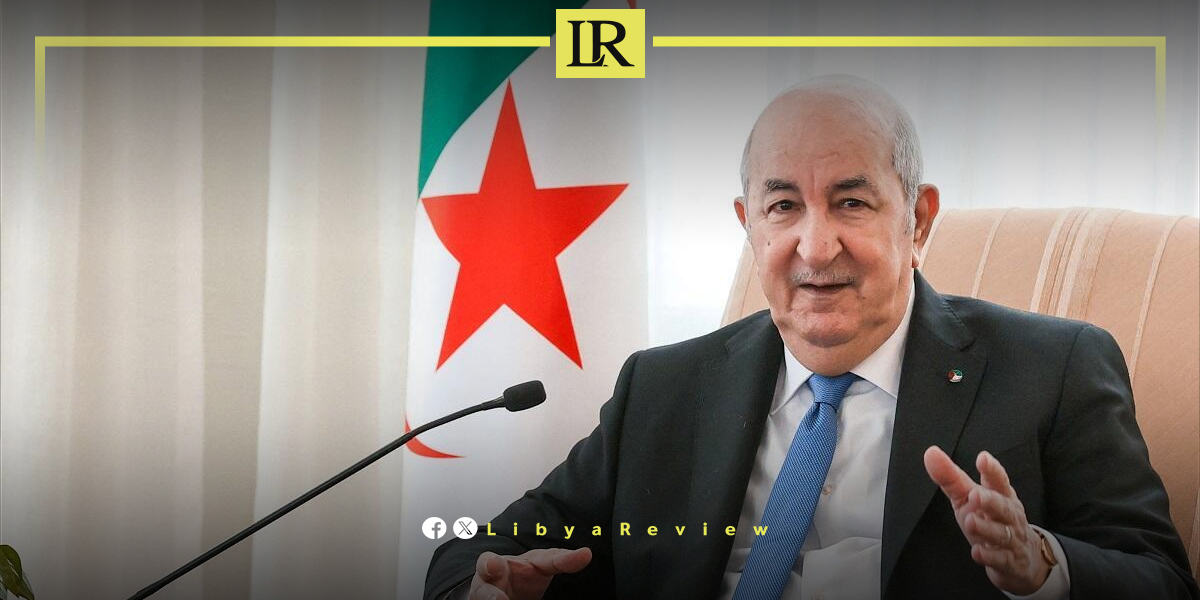
Algerian President Abdelmadjid Tebboune has reiterated that resolving Libya’s prolonged crisis can only be achieved through a Libyan-led political process, firmly rejecting any form of foreign interference. Speaking before Algeria’s parliament, Tebboune described the Libyan conflict as a “deep open wound” that has burdened the region for more than 14 years, with serious political, security, and humanitarian consequences.
Tebboune emphasized that, despite numerous international initiatives and external interventions over the past decade, Libya remains mired in instability, division, and institutional fragmentation. He argued that foreign involvement has not produced a lasting settlement but has instead complicated the crisis and deepened internal rifts among Libyans. According to the Algerian president, imposed solutions and competing external agendas have weakened Libya’s sovereignty and undermined prospects for national reconciliation.
The president emphasized that the only viable and sustainable solution lies in an inclusive internal dialogue among Libyans themselves, leading to fair, transparent, and representative elections. He underlined that legitimacy cannot be restored through external pressure or foreign-backed arrangements, but only through a political process owned by the Libyan people. Tebboune stated unequivocally that “the solution in Libya can only be Libyan–Libyan,” adding that any attempt to sideline Libyans from shaping their own future is destined to fail.
Addressing concerns over regional intentions, Tebboune made it clear that Algeria has no interest in Libya’s wealth or resources. He reaffirmed that Algeria’s stance is guided by principles of non-interference, respect for sovereignty, and commitment to regional stability, rather than political or economic gain. He added that Algeria’s priority is to see Libya restored as a unified, sovereign state capable of managing its own affairs.
Tebboune also highlighted the broader regional implications of Libya’s instability, noting that prolonged conflict fuels cross-border threats such as terrorism, arms trafficking, and irregular migration. He argued that stabilizing Libya would significantly enhance security across North Africa and the Mediterranean.
The Algerian president concluded by reaffirming his country’s readiness to support any genuine Libyan-led initiative aimed at reconciliation and national unity. He stressed that peace in Libya is not only a Libyan necessity but a regional imperative, and that lasting stability can only be achieved when foreign interference ends and Libyans are empowered to determine their own political path.

