
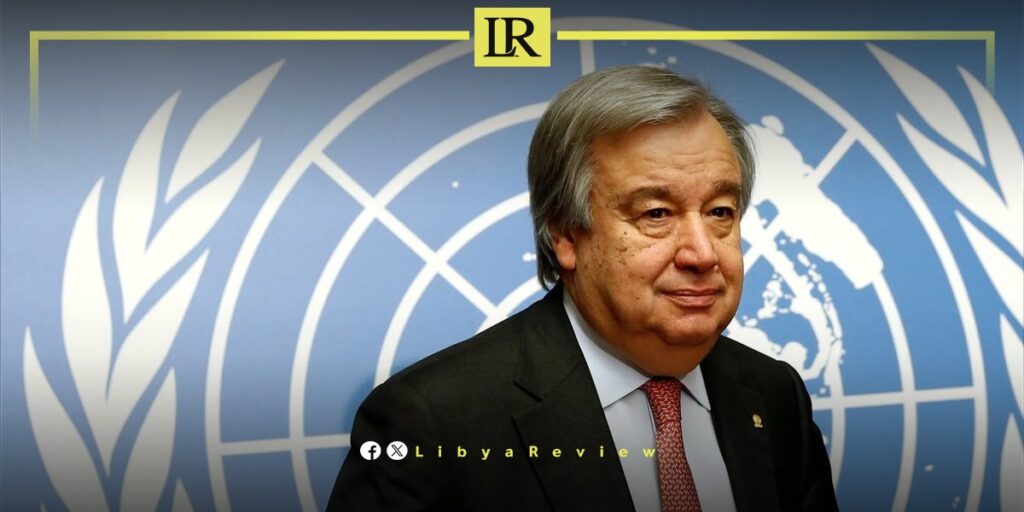
António Guterres has presented a comprehensive report to the United Nations Security Council detailing political, security, economic, and humanitarian developments in Libya, covering the period from November 28, 2025 to March 31, 2026.
The report, issued on April 6, 2026 under document symbol S/2026/281, forms part of the United Nations’ regular monitoring of Libya in line with Security Council resolutions. It outlines ongoing challenges facing the country’s political transition and institutional divisions.
Guterres noted that the United Nations Support Mission in Libya continues to advance a political roadmap introduced by the Special Representative in August 2025. The initiative aims to unify national institutions and bring Libya’s prolonged transitional phase to an end through nationwide elections.
However, the report highlights a lack of tangible progress between the Libyan House of Representatives and the Libyan High Council of State on key electoral issues. These include restructuring the board of the High National Elections Commission and finalising the legal framework governing elections.
According to the report, joint committees from both institutions had previously reached an agreement in November on a mechanism for selecting members of the elections commission’s board, facilitated by UNSMIL. However, the agreed deadline of December 11 was not met.
On December 29, the House of Representatives moved forward with appointing new members to fill vacant positions. The High Council of State rejected the move, citing procedural and legal shortcomings, and called instead for a comprehensive restructuring of the commission.
Guterres stressed that UNSMIL remains a central mediator in Libya’s complex political process, working to bridge divisions and push forward the electoral track. He underlined that the country’s stability remains closely tied to the commitment of Libyan stakeholders to the UN-backed roadmap and to meaningful institutional cooperation.
The report underscores that without consensus on electoral arrangements and unified governance structures, Libya risks prolonging its political stalemate, delaying long-awaited elections and broader state-building efforts.

