
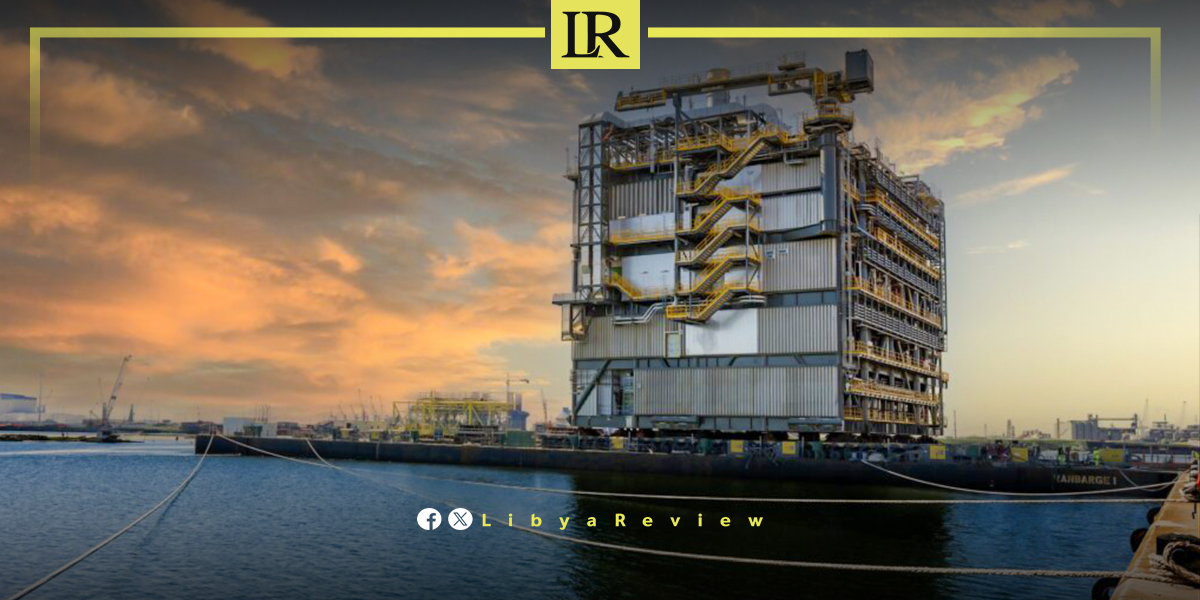
A major offshore module built in Italy for the Bouri Gas Utilization Project has arrived off the Libyan coast, marking a key step in one of Libya’s most important gas recovery projects.
The large module was constructed at Rosetti Marino’s shipyard in Ravenna for a project led by Eni and Libya’s National Oil Corporation. It is designed to recover gas that is currently dispersed or burned through routine flaring at the Bouri offshore oilfield, one of Libya’s largest offshore energy assets.
According to industrial sources cited by Agenzia Nova, the module has already reached the offshore site, with installation operations expected to begin immediately.
The structure weighs more than 5,200 tonnes and stands around 45 metres high. It departed from the port of Ravenna on 7 May aboard a barge bound for the Bouri field, located about 170 kilometres off the Libyan coast. Installation is being supported by the Saipem 7000 crane vessel, one of the largest of its kind in the world.
The infrastructure is a central part of Eni’s energy development plan in Libya, carried out in cooperation with Mellitah Oil & Gas, the joint venture between Eni and the National Oil Corporation.
Once operational, the system will capture, compress, and process associated gas produced during oil extraction at the Bouri field. The project aims to reduce routine flaring, a practice in which excess gas is burned during production operations.
Previous industrial estimates suggest that the project could recover around 3 million cubic metres of gas per day. This would help reduce emissions while increasing gas supplies for Libya’s domestic market, which depends heavily on natural gas for electricity generation.
The arrival of the module comes as coordination between NOC and Eni intensifies on Libya’s major energy projects. NOC Chairman Massoud Suleiman recently met Alessandro Tiani, Eni’s North Africa General Manager, to discuss ways to strengthen cooperation on gas projects and accelerate production.
The talks focused on the Bouri gas recovery project, the A&E offshore facilities, and other programmes aimed at increasing Libya’s gas output.
The Bouri project is considered the second of three major pillars in Eni’s energy strategy in Libya. The first is the Sabratha Compression project, designed to support production at the Bahr Essalam offshore field. The second is the Bouri Gas Utilization Project. The third involves the development of the new A&E offshore structures, described as Libya’s largest energy investment in two decades.
In the medium term, these projects could gradually increase gas volumes available for export to Italy through the GreenStream pipeline, which links Mellitah to Sicily. However, the main priority remains Libya’s domestic market, where rising electricity demand continues to absorb much of national gas production, especially during the summer months.
Libya’s energy file has also become increasingly important for Italy amid continuing tensions in the Gulf and concerns over the security of international energy routes, including the Strait of Hormuz.

