
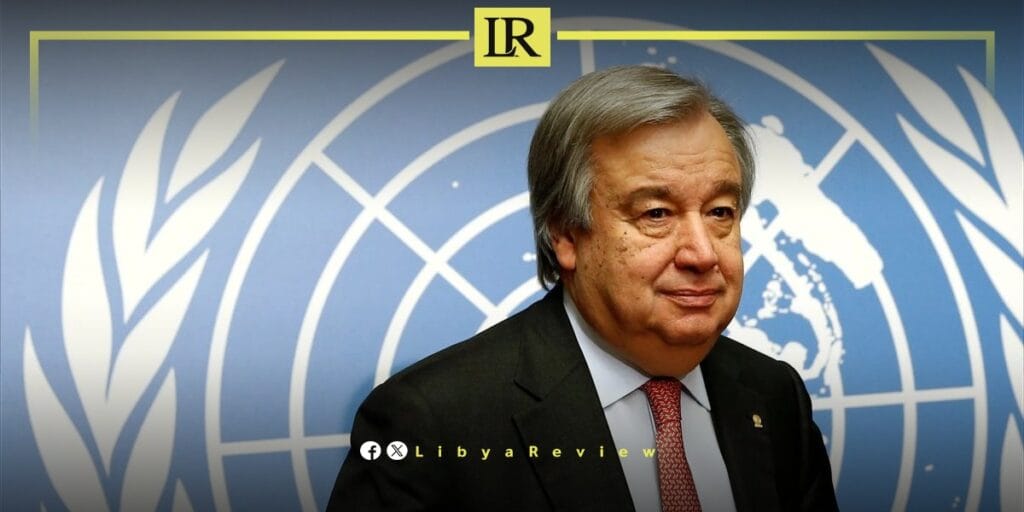
The United Nations Secretary-General has warned that Libya’s prolonged political division remains the main obstacle to stability, calling for urgent steps to unify state institutions and restore effective governance.
In a report submitted to the UN Security Council on the work of the United Nations Support Mission in Libya (UNSMIL), António Guterres reviewed political, security and economic developments in Libya between 2 August and 27 November 2025. The report stresses that Libya’s crisis is “fundamentally political”, driven by institutional fragmentation and the absence of consensus on a constitutional framework to lead the country towards national elections.
Guterres urged Libyan authorities to accelerate the unification of sovereign and executive institutions, describing this as a basic condition for ending division and rebuilding state effectiveness. He also highlighted the need for a unified national budget to ensure financial discipline and curb parallel spending that lacks transparency.
On the economic front, the report noted that oil production remains stable at around 1.4 million barrels per day. However, it warned that weak oversight of public finances, illicit practices and the continued diversion of subsidised fuel are undermining Libya’s economy. Guterres called for stronger control over smuggling networks and enhanced supervision of public funds.
Security concerns remain acute, particularly in Tripoli and western Libya, where recurring tensions have brought the capital close to wider confrontations. While the Joint Military Commission (5+5) continues to play a key role in preventing escalation, the report said its effectiveness is limited without unified political backing.
The Secretary-General also raised serious human rights concerns, calling for the release of arbitrarily detained individuals, an end to unlawful detention practices and greater judicial accountability. He stressed the importance of full cooperation with the International Criminal Court and the fight against impunity.
On the political process, Guterres welcomed the technically successful conduct of municipal elections but cautioned that this does not signal imminent national elections. He urged Libyan authorities to support and protect the High National Elections Commission to safeguard the integrity of any future vote.
The report further called for intensified efforts on disarmament, reintegration, transitional justice and reparations, while emphasising the need to expand the participation of women, youth and civil society in political dialogue and decision-making.

