
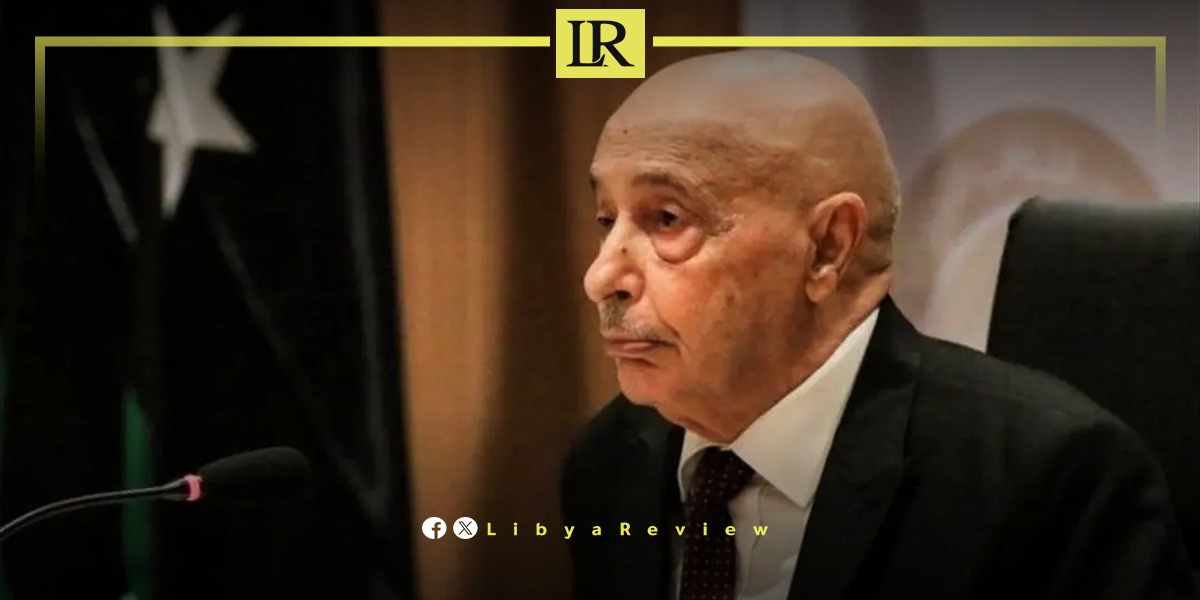
The Speaker of Libya’s House of Representatives, Ageela Saleh, delivered strong criticism today, accusing prominent political figures of intentionally stalling the country’s political path and undermining efforts to hold national elections.
In a televised interview, Saleh said that the current political deadlock and failure to form a unified interim government reflect deliberate obstruction by the government led by Abdul-Hamid Dbaiba and the head of the High Council of State, Mohamed Takala. He claimed their actions have closed every avenue for a consensual, comprehensive solution and made the formation of a unified government an unattainable goal.
Saleh asserted that the political landscape has become dominated by interests that are more focused on preserving positions of influence than advancing the transition process. According to him, this has effectively shut the door to national elections, prolonging the ongoing crisis and deepening institutional gridlock.
To break the stalemate, the Speaker proposed the establishment of a special electoral committee tasked exclusively with organizing and executing national elections. This committee — he explained — would not engage in executive or partisan activities, but would focus solely on facilitating the electoral process. Its membership would include judicial oversight and representatives responsible for security coordination across Libya, as well as technical leadership from the electoral commission to manage logistical requirements.
Saleh emphasized that this proposal is intended to circumvent political rivalries and power struggles that have repeatedly thwarted attempts to move forward. He stressed that moving directly to elections, under the supervision of a neutral body, is the most practical solution to end the transitional impasse.
The Speaker also criticized what he described as a lack of political will among key figures, particularly pointing to the absence of genuine commitment to dialogue and compromise. He noted that attempts to revive previous agreements and distribute sovereign positions have repeatedly stalled at critical moments, exposing fragmented priorities among different factions.
In defending his parliamentary institution, Saleh reiterated his commitment to upholding its role as the legitimate legislative authority. He insisted that Libya’s path toward stability and democratic transition hinges on overcoming deliberate political obstruction and focusing on election preparation as the sole way out of the cycle of division.

