
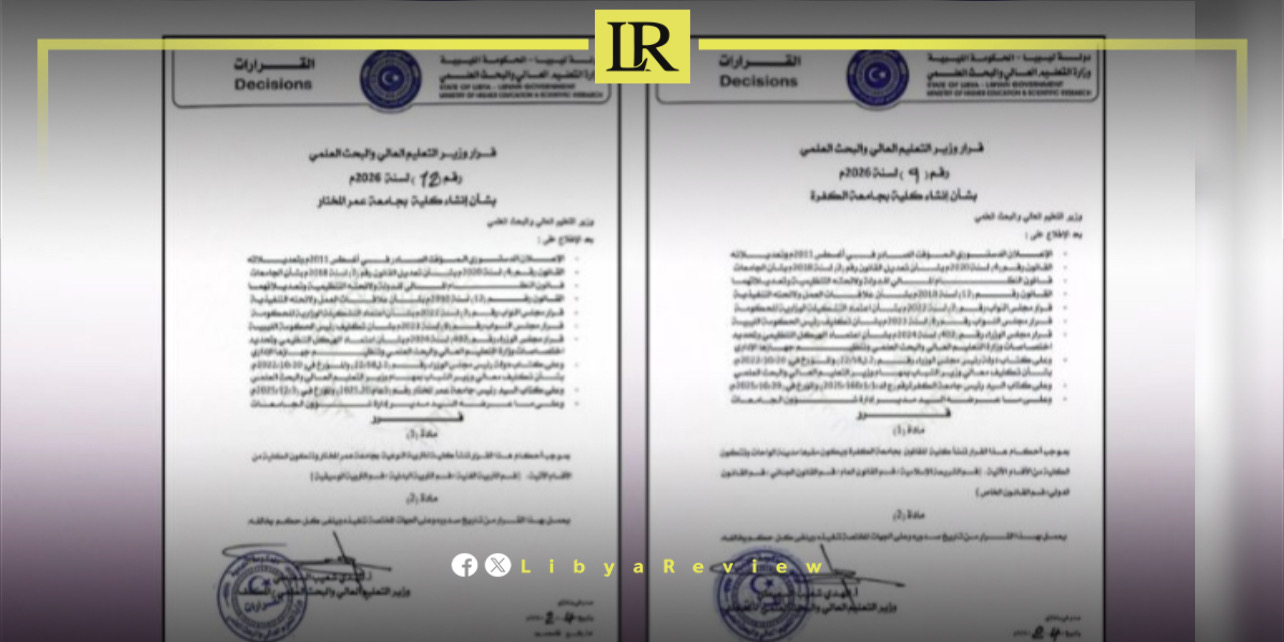
Libya’s Ministry of Higher Education and Scientific Research has approved the establishment of two new academic faculties at the Universities of Omar Al-Mukhtar and Kufra, as part of a national plan to expand higher education services and improve access for students in remote and underserved regions.
The decisions were issued by the Minister of Higher Education and Scientific Research in the Libyan government, Mahdi Shuaib Al-Saiti, within a broader package of organizational measures aimed at strengthening academic institutions and aligning university programs with labor market needs and regional development priorities.
Under Decision No. 12 of 2026, a Faculty of Specific Education will be created at Omar Al-Mukhtar University. The new faculty is expected to contribute to the development of specialized educational programs and to enhance teacher preparation in several disciplines, supporting national efforts to improve the quality of education and professional training.
In a separate decision, No. 9 of 2026, the minister approved the establishment of a Faculty of Law at Kufra University, with its headquarters to be based in the Oasis city area. The move is intended to bring legal education closer to students in southern Libya, reducing the need for long-distance travel to other cities and easing financial and social pressures on families.
According to the ministry, the creation of new faculties reflects a commitment to achieving balanced educational development across the country. For years, students in remote areas such as Kufra and surrounding regions have faced limited access to specialized university programs, often forcing them to relocate or abandon higher education altogether.
Officials stressed that expanding university infrastructure in these regions will help increase enrollment, retain local talent, and support social and economic development. The new colleges are also expected to contribute to producing qualified graduates capable of meeting the needs of public institutions and the private sector.
The ministry noted that implementation will proceed in coordination with the respective universities, including preparations related to academic staff, curricula, and facilities, to ensure that the new faculties meet national standards. The decisions form part of a wider strategy to modernize Libya’s higher education system and strengthen the role of universities in national development.

