
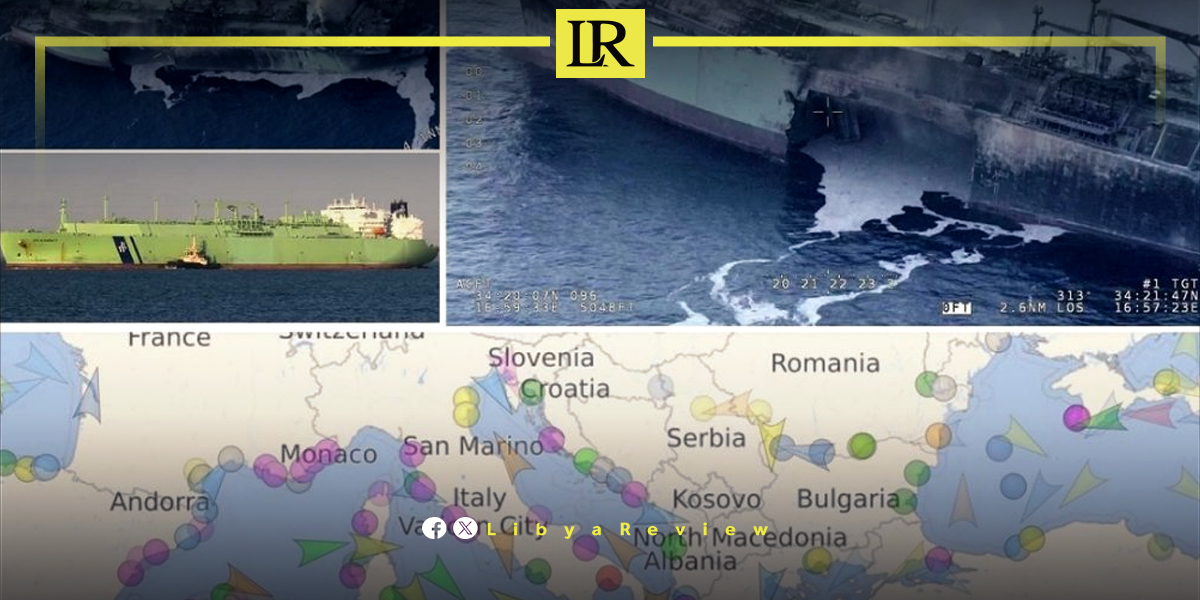
European concerns are mounting over the risk of a major environmental disaster in the Mediterranean Sea following severe damage to the Russian gas tanker Arctic Metagaz off the Libyan coast earlier this month. The vessel, reportedly carrying more than 60,000 tons of liquefied natural gas (LNG) and around 900 tons of diesel fuel, poses a significant threat to marine ecosystems if a leak or explosion occurs.
According to regional reports, the tanker sustained heavy damage after an attack attributed to Ukrainian forces in early March. The incident has raised alarm among European authorities due to the vessel’s hazardous cargo and its proximity to sensitive coastal areas.
Authorities in Malta and Italy have warned that the damaged tanker drifted dangerously close to Maltese waters. Its last known position placed it approximately 50 nautical miles southwest of Malta. Aerial images published by a French outlet showed a partially burned hull leaning to one side, with visible smoke and a wide oil slick spreading across the sea surface.
The vessel is believed to be part of Russia’s so-called “shadow fleet,” a network of aging ships used to bypass international sanctions by disabling tracking systems. Experts warn that such vessels often operate under poor safety standards, increasing the risk of accidents and complicating emergency response efforts.
The World Wide Fund for Nature (WWF) has cautioned that any gas leak or ignition could trigger uncontrollable fires and long-term environmental damage, particularly given shifting wind patterns and sea currents in the Mediterranean basin.
In response to the escalating threat, Italy and Malta have deployed tugboats and anti-pollution teams, preparing for rapid intervention. Authorities are reportedly considering multiple options, including towing the vessel to a secure port or, as a last resort, deliberately sinking it in controlled conditions to minimize wider environmental impact.
Libyan authorities, however, stated that a series of explosions followed by a massive fire caused the tanker to sink in international waters north of Sirte Port on the night of March 3–4. Meanwhile, Moscow described the incident as a “coordinated attack” carried out by Ukrainian drones, confirming that all 30 crew members were safely rescued.
Estimates of Russia’s “shadow fleet” vary widely, ranging from 600 to 1,500 vessels. Some reports suggest similar networks are also used by Iran and North Korea, highlighting the growing scale of unregulated maritime operations and their potential risks to global shipping and environmental safety.
The incident underscores rising geopolitical tensions and the environmental vulnerabilities of the Mediterranean, a region already facing increasing ecological pressures.

