
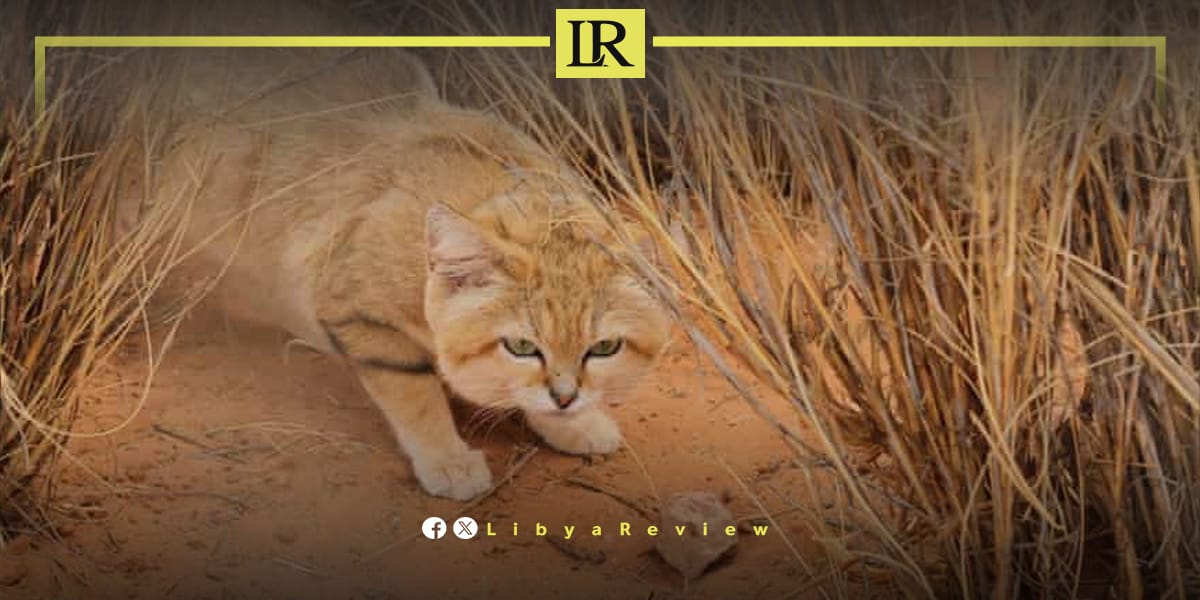
A rare desert predator known as the “ghost of the desert” has been confirmed in Libya for the first time through scientific evidence, with new research suggesting the country’s south-western Sahara may be an important refuge for the elusive sand cat, according to a report by The Guardian.
The discovery began in 2017 when Libyan wildlife photographer Mohammed Almuntasir uploaded an 18-second video showing a sand cat digging in the dunes of south-west Libya. At the time, many experts doubted the footage, as no confirmed evidence had previously documented the species in the country.
Nearly a decade later, the video has led to a major scientific breakthrough.
Almuntasir later collaborated with zoologist Firas Hayder, a specialist in small carnivores and postdoctoral researcher at South Africa’s Sol Plaatje University. The pair conducted an eight-year study, largely through remote cooperation, to document the species in Libya.
Their findings, published in the Journal of Arid Environments in February 2026, confirmed the presence of sand cats at 13 locations across the Libyan Sahara. Researchers also identified new populations of the Saharan striped polecat.
The study found that 15 of the 36 documented sand cat sightings were concentrated in Wadi Armet, an isolated valley around 1,000 kilometres south-west of Tripoli. Researchers believe the area may represent a previously unrecognised stronghold for desert-adapted wildlife.
However, scientists warned that Libya’s south-west remains one of North Africa’s least studied environments, lacking protected areas, research infrastructure and security due to smuggling activities near the borders with Algeria, Niger and Chad.
Researchers also documented cases of sand cats being sold in local markets and accidentally killed by hunters. Conservationists say protecting the species is vital because sand cats help control rodent populations and maintain the fragile balance of desert ecosystems.
The findings have highlighted the rich but largely unexplored biodiversity hidden in Libya’s vast Sahara.

