
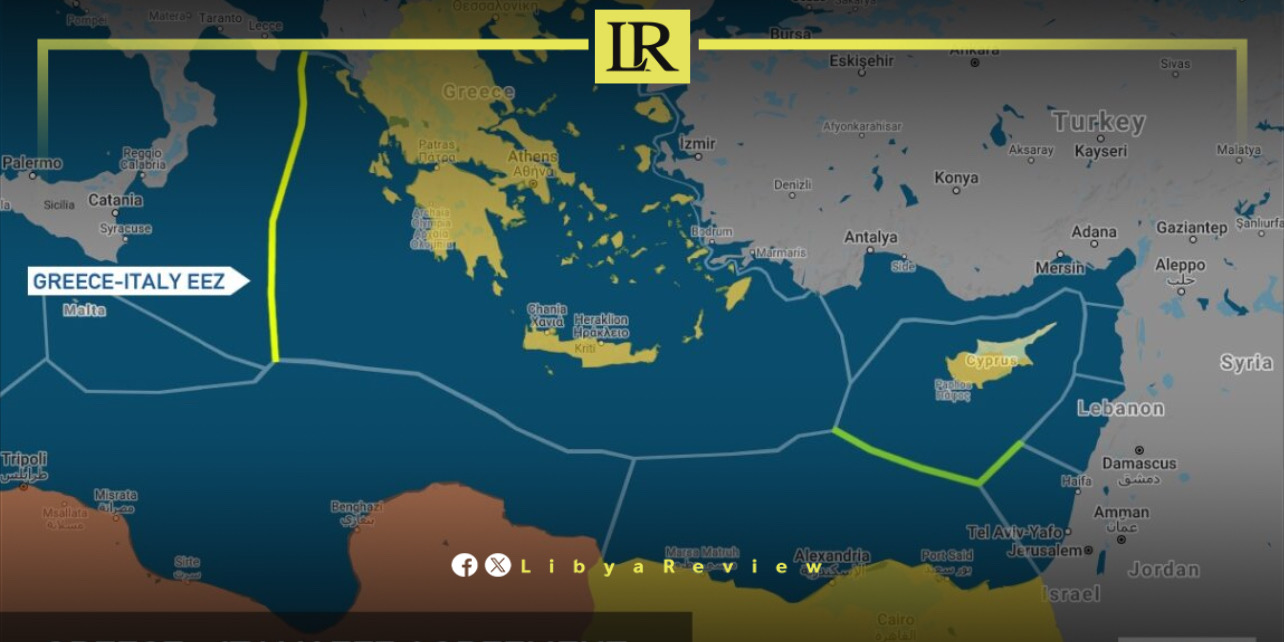
Italy and Tunisia have formally challenged Libya’s unilateral maritime claims at the United Nations, in a move seen as strengthening Greece’s legal and diplomatic position in the wider Mediterranean dispute.
The objections come amid renewed tensions over Libya’s maritime position, which is linked to the controversial 2019 Turkey-Libya maritime memorandum. The agreement has long been rejected by Greece, which argues that it ignores the rights of Greek islands, including Crete, in determining maritime zones.
Libya submitted a note verbale to the United Nations on 27 May 2025, accompanied by a map setting out its position on the outer limits of its continental shelf in the Mediterranean Sea. Greece strongly opposed the move, saying it attempted to extend Libyan claims into areas that Athens considers part of the Greek continental shelf south of Crete.
Italy submitted its own note verbale to the UN on 26 May 2026, rejecting parts of Libya’s position. Rome argued that Libya’s claimed outer limits violate Italian rights under the Law of the Sea, particularly in areas east of the 15°10′ E meridian and west of the 13°50′ E meridian. These lines are linked to the International Court of Justice’s 1985 ruling in the Libya-Malta Continental Shelf case.
Italy also called for dialogue with Libya, stressing the need to resolve maritime disagreements through negotiation and in accordance with international law.
Tunisia separately objected to Libya’s demarcation in a communication to the UN dated 19 April 2026. Tunis said Libya’s position was inconsistent with the 1982 International Court of Justice ruling in the Tunisia-Libya Continental Shelf case, as well as with the 1988 bilateral agreement signed between the two countries.
Tunisia argued that Libya’s proposed lateral boundary was excessive and legally unfounded. It also disputed Libya’s unilateral definition of outer maritime limits and its contiguous zone, while calling for sincere negotiations based on good faith and international law.
The Italian and Tunisian objections add to previous opposition from Greece and Egypt, both of which have challenged Libya’s maritime claims in recent years. For Athens, the latest developments provide additional diplomatic support against the Turkey-Libya memorandum and Libya’s related maritime assertions.
Greece has continued to push back through both diplomacy and energy policy. Athens has held technical discussions with the Tripoli-based government over maritime delimitation, while also maintaining contact with eastern Libyan authorities. Greek officials have raised the issue directly with Commander-in-Chief of the Libyan National Army Khalifa Haftar during high-level visits to Benghazi.
At the same time, Greece has moved ahead with offshore energy exploration south and southwest of Crete. A Chevron-led consortium signed agreements in February 2026 to explore natural gas in four deep-water areas off southern Greece, including near Crete and the Peloponnese.
Some of these exploration areas overlap with maritime zones claimed by Libya under the framework of the Turkey-Libya memorandum. Greece maintains that its licensing policy follows the median line principle and is consistent with the Law of the Sea, including the rights of islands to maritime zones.
With no immediate bilateral settlement in sight, Athens is expected to continue preparing for a possible legal referral to the International Court of Justice in The Hague. Such a case could address not only the Greece-Libya maritime dispute, but also the broader legal implications of the Turkey-Libya memorandum.
The growing number of objections to Libya’s unilateral maritime claims highlights the complexity of Mediterranean maritime disputes, where energy interests, regional alliances and competing interpretations of international law continue to shape diplomatic tensions.

