
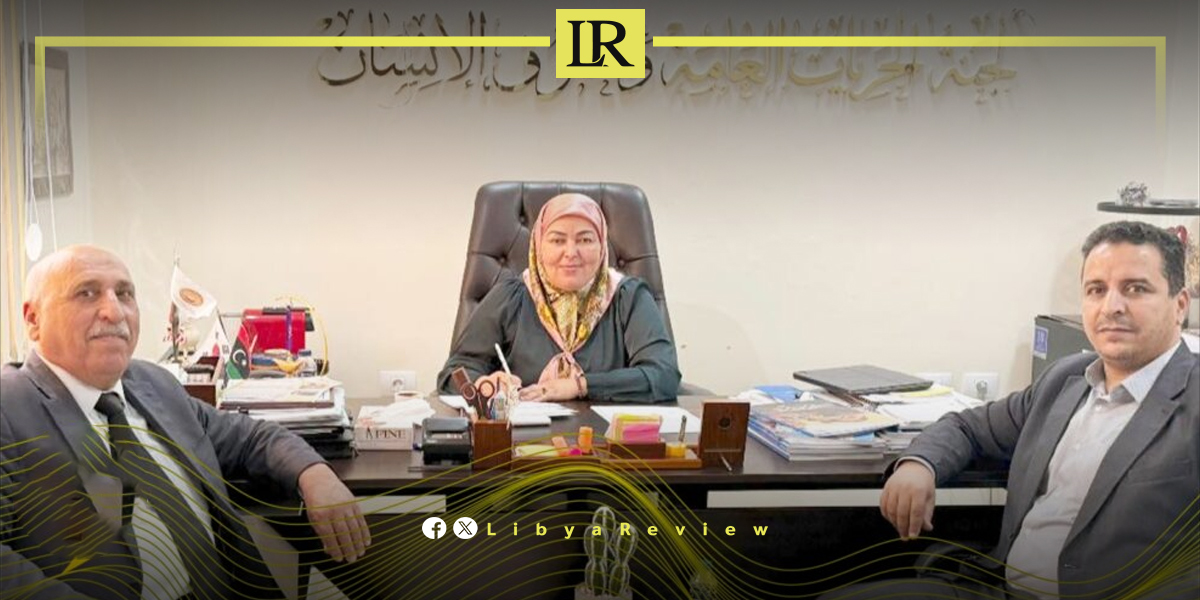
The Head of the National Committee for Sustainable Development at the Libyan House of Representatives, MP Rabia Bouras, held a meeting today with the Director-General of the City of Science and Technology, Dr. Moftah Ahmed Aburqi’a, in the presence of Dr. Ghaith Jumaa Said, Legal Affairs Advisor at the City.
According to Bouras’ statement, the meeting discussed mechanisms for joint cooperation in the fields of scientific research, innovation, and digital transformation. The goal is to contribute to achieving the United Nations Sustainable Development Goals (SDGs) 2030, build national capacities, and develop technological solutions that support Libya’s development path.
During the discussions, it was revealed that Libya has 55 specialized research centers across various disciplines, with branches spread throughout cities and regions. These institutions aim to strengthen the role of scientific research in achieving sustainable development and advancing the well-being of society.
Bouras affirmed that this initiative underscores the committee’s commitment to promoting scientific and technological development as a cornerstone for reconstruction and economic growth in Libya.
Libya has been in chaos since a NATO-backed uprising toppled longtime leader Muammar Gaddafi in 2011. The county has for years been split between rival administrations.
Libya’s economy, heavily reliant on oil, has suffered due to the ongoing conflict. The instability has led to fluctuations in oil production and prices, impacting the global oil market and Libya’s economy.
The conflict has led to a significant humanitarian crisis in Libya, with thousands of people killed, and many more displaced. Migrants and refugees using Libya as a transit point to Europe have also faced dire conditions.
The planned elections for December 2021 were delayed due to disagreements over election laws and the eligibility of certain candidates. This delay has raised concerns about the feasibility of a peaceful political transition.
Despite the ceasefire, security remains a significant concern with sporadic fighting and the presence of mercenaries and foreign fighters. The unification of the military and the removal of foreign forces are crucial challenges.

