
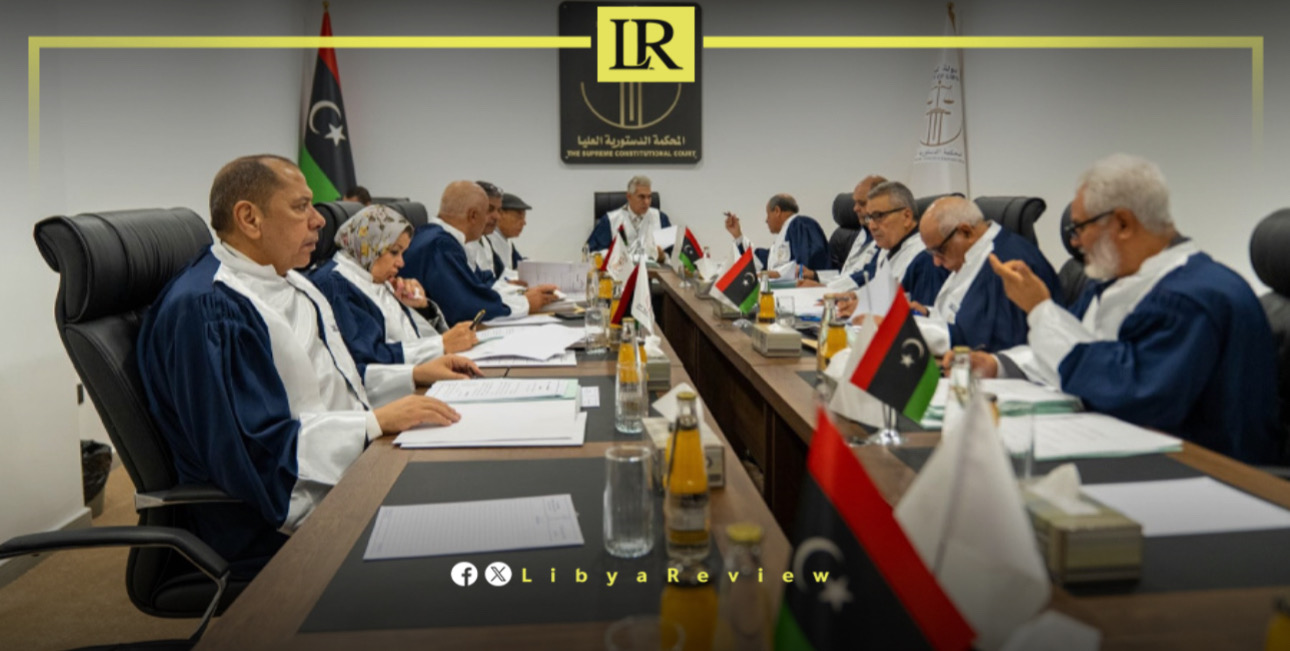
Libya’s High Constitutional Court in Benghazi has ruled that a recent decision by the Supreme Court declaring four parliamentary laws unconstitutional is itself null and void, stating that the Supreme Court lacks jurisdiction over constitutional disputes.
In a statement released Sunday, the High Constitutional Court said its ruling followed a case filed by House Speaker Ageela Saleh, who challenged the authority of the constitutional chamber of the Supreme Court of Libya to invalidate legislation passed by the Libyan House of Representatives.
In late January, the Supreme Court’s constitutional chamber ruled that four laws issued by parliament were unconstitutional. These included Law No. 22 of 2023, Law No. 32 of 2023, Law No. 6 of 2015 on general amnesty, and Law No. 1, which annulled laws enacted by the former General National Congress after August 3, 2014.
The House of Representatives had previously passed legislation in January 2020 declaring that all laws and decisions issued by the General National Congress after its final session were invalid, while maintaining that legislation issued before that date would remain in force unless amended or repealed.
The High Constitutional Court’s latest ruling intensifies an already escalating judicial confrontation in Libya. The dispute centers on which institution has the legal authority to interpret the constitution and review parliamentary legislation. In December 2022, parliament passed a law establishing a separate Constitutional Court headquartered in Benghazi and transferring constitutional review powers away from the Supreme Court’s constitutional chamber. The same law also renamed the Supreme Court as the Court of Cassation.
Parliament has argued that existing judicial legislation does not grant the Supreme Court jurisdiction over constitutional appeals. Critics, however, say the move deepens institutional division and risks further fragmenting Libya’s judiciary.

