
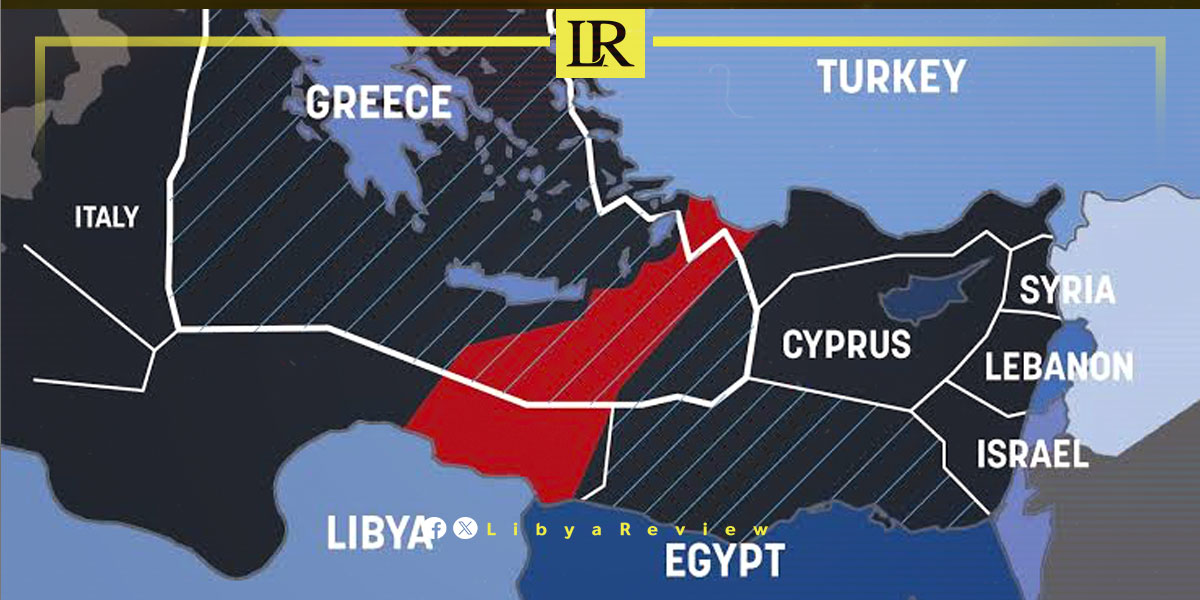
A Greek analytical report has called for the long-running maritime boundary dispute between Libya and Greece to be referred to the International Court of Justice (ICJ) in The Hague, arguing that judicial arbitration offers the most effective path to resolving competing claims in the eastern Mediterranean.
The report, published by the English-language Greek newspaper Kathimerini, described Libya as presenting a significant diplomatic opportunity for Greece because several Mediterranean countries have formally objected to Libya’s maritime claims submitted to the United Nations.
According to the analysis, Libya’s letter to the UN on May 27, 2025, which included a map outlining its maritime boundaries in the Mediterranean, prompted official objections from Egypt, Greece, Italy, Malta, and Tunisia. The report estimated that the area covered by Libya’s maritime claims extends across roughly 16% of the Mediterranean Sea and overlaps with the interests of five neighboring coastal states.
The report argued that the authorities in Tripoli are unlikely to negotiate a comprehensive maritime agreement with Greece covering areas included in the 2019 Libya-Turkey maritime memorandum, as doing so could create tensions with Ankara, which remains an important political and security partner for Libya.
It also suggested that Libya could instead seek to delimit only the western section of its maritime boundary, outside the area covered by the agreement with Turkey. However, the report argued that Greece would likely reject such a proposal, viewing it as an implicit recognition of the existing Libya-Turkey maritime arrangement in the eastern Mediterranean.
As an alternative, the analysis proposed that Greece coordinate with Egypt, Italy, Malta, and Tunisia to jointly encourage Libya to refer the dispute to the International Court of Justice. It noted that Libya has previously submitted maritime disputes with both Tunisia and Malta to the ICJ during the 1980s, demonstrating a precedent for resolving maritime boundary disagreements through international judicial mechanisms.
The report also argued that a legally defined maritime boundary could provide greater certainty for international energy companies seeking to invest in offshore oil and gas exploration, reducing disputes over continental shelves and exclusive economic zones.
The analysis further predicted that Turkey would oppose any attempt to include areas covered by the 2019 maritime memorandum in an ICJ case, potentially challenging the court’s jurisdiction or seeking to exclude those waters from judicial review.

