
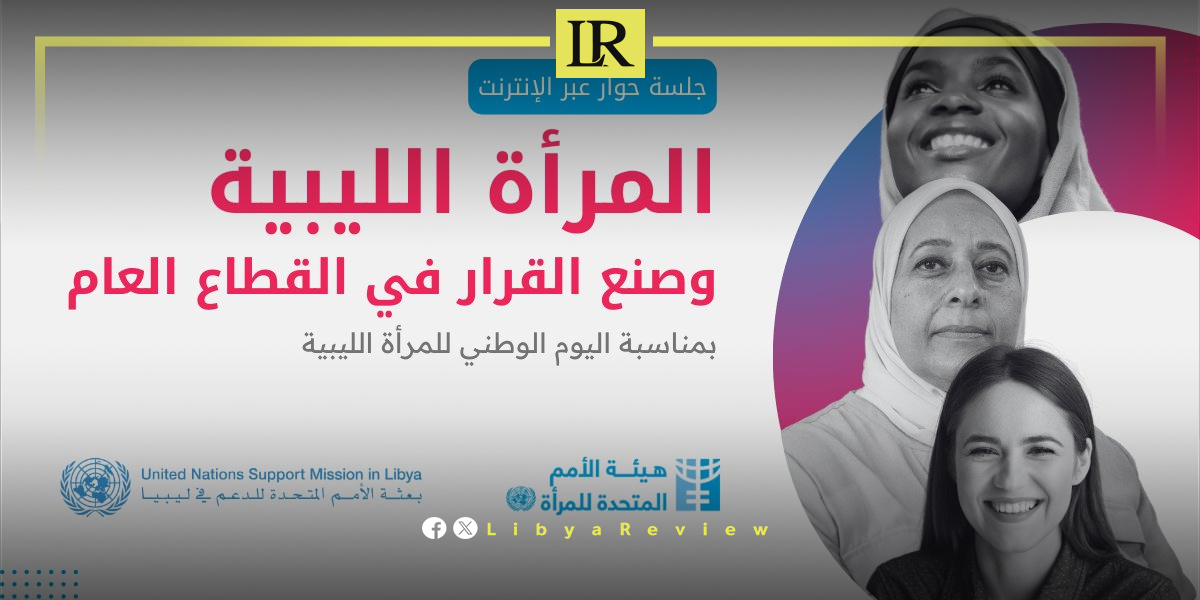
A new study released by UN Women has revealed that although Libyan women make up 46% of the government workforce, their representation in senior leadership and decision-making positions remains disproportionately low.
The findings were presented during a virtual event co-hosted by the United Nations Support Mission in Libya (UNSMIL) and UN Women, in honor of Libya’s National Women’s Day. More than 70 women from across the country participated in the session, alongside Libya’s Minister of State for Women’s Affairs, Huria Termal, and UN Women’s representative for Libya and Tunisia, Florence Raes Basti.
According to the study, Libyan women are heavily concentrated in sectors like education and healthcare—accounting for 70% of employees in education and 63% in healthcare—but are almost entirely absent in more politically or security-oriented fields such as defense (4%) and interior affairs (7%). Most women, the report found, remain in lower administrative roles, rarely progressing to executive or policy-making positions.
Minister Termal stressed the need for unified efforts—both domestic and international—to promote gender equality in leadership. She encouraged Libyan women to assert their presence across all sectors and highlighted their resilience despite persistent social and institutional challenges.
Florence Basti emphasized that data alone isn’t enough and urged Libyan institutions to convert these findings into concrete reforms. She called for safer, more inclusive workplaces and transparent promotion systems based on merit—not gender.
Human rights lawyer Hala Bugaighis, who presented the findings, echoed the need for systemic change. The study recommends reviewing outdated legal frameworks, investing in leadership training for women, and activating gender empowerment offices across ministries.
The report concludes that unless deliberate measures are taken, Libyan women—despite their strong presence in the workforce—will remain locked out of key decision-making spaces, weakening the country’s democratic and institutional progress.

