
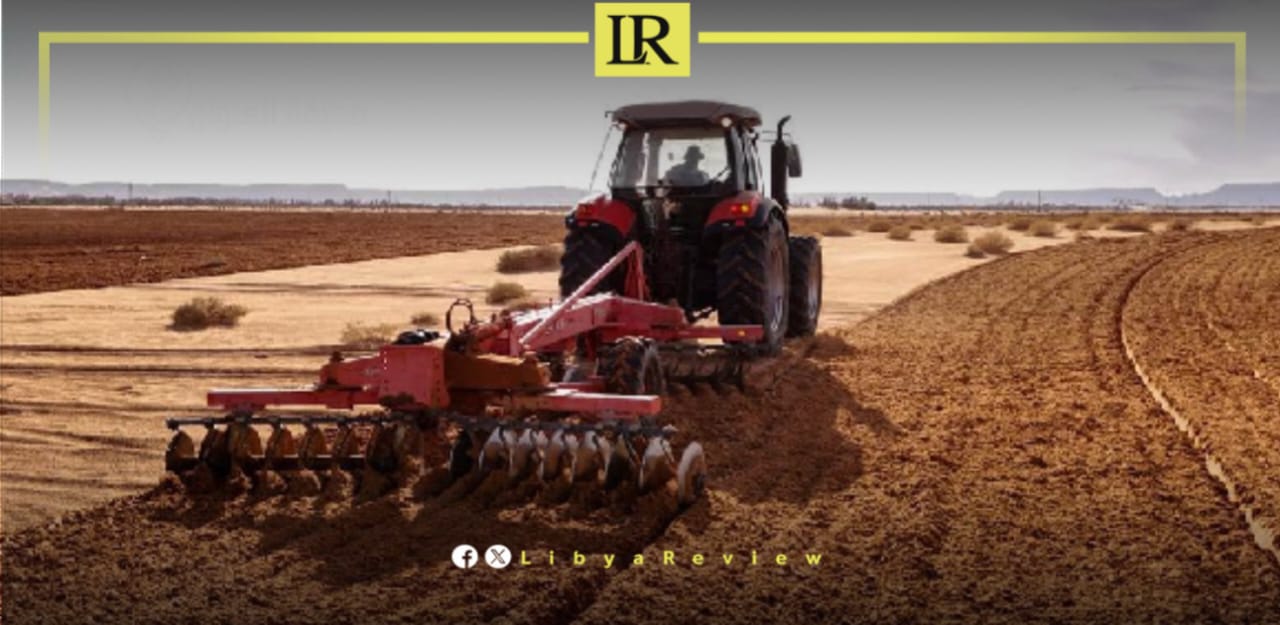
The Libyan Arab Armed Forces General Command is spearheading a comprehensive development drive in Libya’s agricultural sector through the National Development Agency, which has taken a central role in planning, implementing, and overseeing productive agricultural projects across the country, with a particular focus on southern Libya.
Iraoun Agricultural Project
Work is continuing at a steady pace on the Iraoun productive agricultural project in the municipality of Ubari, one of the flagship development initiatives aligned with the General Command’s Libya Vision 2030. The project aims to consolidate sustainable development and strengthen food security, especially in the southern regions.
The project includes 16 agricultural fields operating under central pivot irrigation systems. Current activities involve harvesting, collection, and baling operations across eight fields planted with alfalfa, as part of the operational plan for the current agricultural season. This marks the project’s transition into active production and the achievement of tangible results on the ground.
The National Development Agency stated that, beginning in early 2026, cultivation will commence on eight additional fields, with a further four new fields to be added in the following agricultural season. This phased expansion is intended to raise production capacity, stabilize agricultural activity, and establish a sustainable production base serving both the local area and the national economy.
Wheat and Barley Under the Al-Dissa Project
In parallel, plowing operations have begun at the Al-Dissa agricultural project in Ubari, marking the first phase of the initiative supervised by the National Development Agency. This step followed the completion of route redesign works and the rehabilitation of the electricity network, reflecting an integrated approach to resolving infrastructure and technical challenges prior to cultivation.
Current operations include plowing the fourth field out of a total of seven, in preparation for planting wheat and barley as the initial crop rotation. The move aims to support the production of strategic crops and reduce reliance on imports.
The National Development Agency emphasized that these projects demonstrate the General Command’s seriousness in transforming challenges into real production opportunities by investing in agriculture as a cornerstone of economic development, while enhancing sustainability in desert areas that had long remained outside effective investment cycles.
Beyond production, the Al-Dissa project seeks to create sustainable local economic investments, diversify income sources, provide stable employment, promote a culture of productivity, and reduce dependence on public-sector jobs—thereby supporting comprehensive development in southern Libya.
Giant Agricultural Project in Wadi Atba
As part of the expansion of strategic agricultural initiatives, the National Development Agency previously announced the launch of a giant agricultural project in Wadi Atba, southwest Libya. The project is among the largest agricultural ventures in the region and is being implemented in line with directives from the General Command to build a strong national agricultural production base.
The initiative aims to connect and develop agricultural projects in Barjوج, Tasawah, and Maknusa into a single, high-efficiency production system comprising around 1,000 central pivot irrigation units, each covering 50 hectares. All units are scheduled to enter service during the 2027–2028 agricultural season.
The project is being implemented in partnership between the National Development Agency and Farm Tech, a firm specialized in agricultural and environmental machinery and technologies, with extensive experience in large-scale agricultural projects, particularly in desert environments.
Vision 2030 and Turning the Desert into Productive Land
These strategic projects are designed to support national food security by increasing agricultural output and boosting the production capacity of strategic crops. They also rely on advanced pivot irrigation technologies, agricultural mechanization, and efficient water resource management to reduce waste and achieve environmental sustainability.
The General Command’s initiatives seek to transform desert regions into sustainable agricultural production zones, develop national expertise, and transfer technical knowledge in the operation and management of large-scale agricultural projects. The broader objectives include strengthening self-sufficiency and reducing the national import bill.
These development efforts come as the International Monetary Fund projects Libya to achieve the highest economic growth rate in the Arab world in 2025, at 17.3%, driven by accelerating reconstruction and development projects under Libya Vision 2030, overseen by the General Command of the Libyan Arab Armed Forces. The vision aims to build a diversified and sustainable economy that enhances stability and delivers comprehensive development nationwide.

