
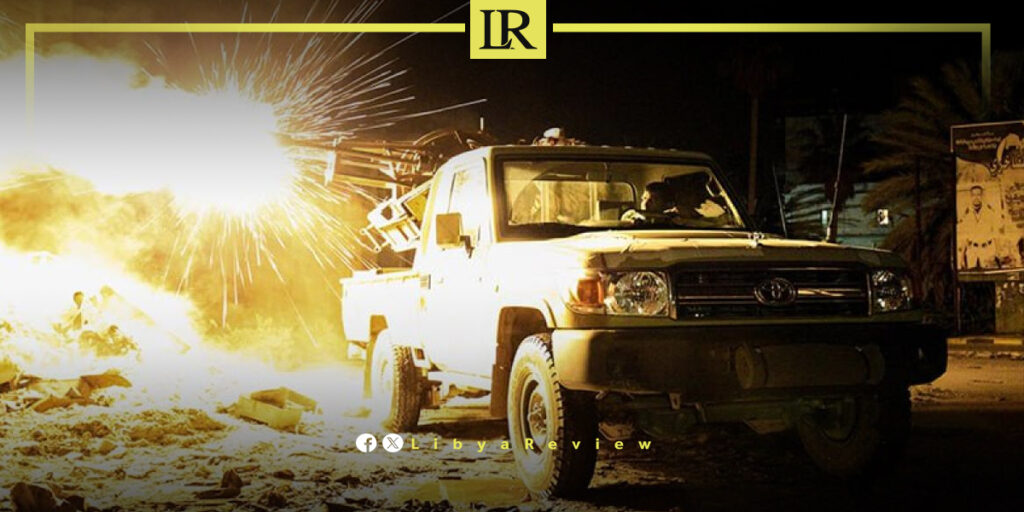
Fresh armed clashes broke out in the western Libyan city of Al-Zawiya on Tuesday, raising renewed concerns over security in one of the country’s most volatile urban centres.
Local social media pages reported that the fighting erupted between rival armed groups in the Terfas area and near the Bashkar intersection from the early hours of the morning. The clashes reportedly involved forces affiliated with a commander identified as Salem Al-Tayef and a rival group linked to a figure known as Al-Shalabi.
According to local reports, several armoured vehicles were set ablaze during the confrontation.
Al-Zawiya, located around 42 kilometres west of Tripoli, has witnessed repeated outbreaks of violence involving rival armed factions competing for influence in the city and surrounding areas.
As of Tuesday, no official statement had been issued by the Ministry of Interior of the Government of National Unity, led by Prime Minister Abdul Hamid Dbaiba, or by the Al-Zawiya Security Directorate regarding the latest clashes.
The renewed violence comes weeks after the United Nations Support Mission in Libya (UNSMIL) warned of a deteriorating security situation in Al-Zawiya. In a statement issued in May, the mission expressed deep concern over reports of continued mobilisation by armed groups and a growing number of assassination incidents in the city and nearby districts.
UNSMIL warned that escalating tensions could trigger a new wave of violence and place civilians at increased risk.
The latest clashes follow a major security operation launched by the Zawiya Security Directorate in May. At the time, authorities said the campaign targeted criminal hideouts, wanted suspects and individuals accused of threatening public security and social stability.
Previous fighting in the city resulted in significant casualties. Local medical and security sources reported that at least 10 people were killed and 20 others injured during clashes that erupted on 8 May.
The latest developments underline the continuing security challenges facing western Libya despite repeated calls from local and international actors for restraint and de-escalation.

