
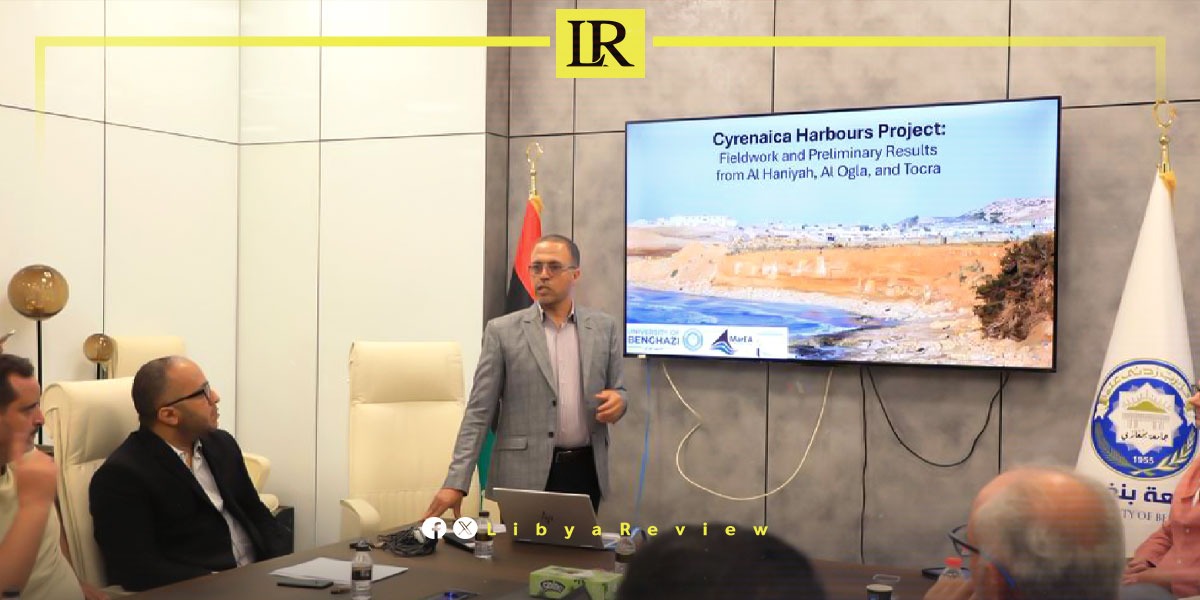
The University of Benghazi has reviewed progress on a joint research project with an Irish university aimed at documenting and protecting endangered maritime archaeological sites affected by climate change across the Middle East and North Africa.
The scientific meeting, held on Tuesday at the University of Benghazi, brought together researchers and specialists in archaeology, environment and geology to discuss the latest developments in the MARIA project, which focuses on rescuing and safeguarding coastal and underwater heritage sites at risk.
Ahmed Saad Miloud, a faculty member at the Department of Archaeology at the University of Benghazi, a member of the Libyan Archaeological Survey Committee and Director of the university’s International Cooperation Office, said the project aims to record and document coastal and submerged archaeological sites.
He explained that the initiative also monitors damage caused by rising waves and climate change, particularly along coastal fronts and marine archaeological sites that face increasing environmental pressure.
Miloud said a team of divers had carried out field diving operations to document several underwater antiquities. He added that the project also includes specialised studies in environment, geology and plant diversity, with the participation of research teams from the Department of Botany at the Faculty of Science and the Department of Geology at the University of Benghazi.
The meeting also included presentations on several research projects linked to the MARIA initiative. These included a study of ancient ports in the Cyrenaica region, extending from Tocra through Al-Aqila to Al-Haniya.
The project aims to train University of Benghazi students and researchers from Libya’s Department of Antiquities in the latest methods of documenting and recording coastal archaeological sites and underwater heritage.
Miloud said the international scientific cooperation reflects the University of Benghazi’s commitment to expanding research partnerships and benefiting from global expertise in protecting and preserving maritime cultural heritage.
The project comes amid growing concern over the impact of climate change on archaeological sites in coastal regions, where rising sea levels, stronger waves and environmental erosion pose increasing risks to historic remains.

