
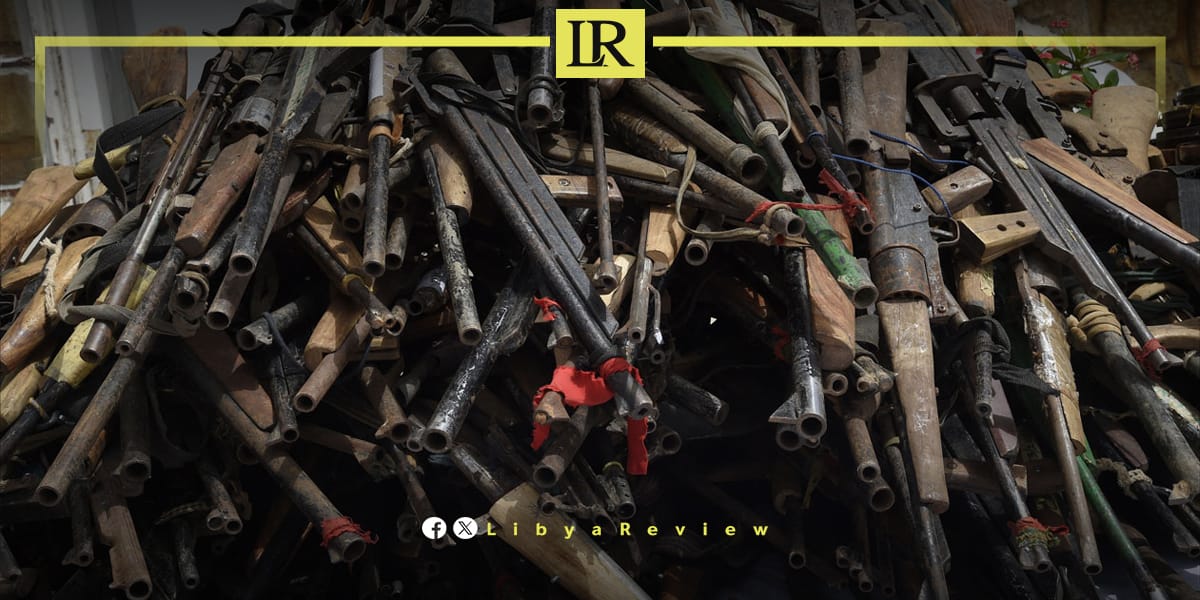
International reports estimating that nearly 29 million weapons are in circulation across Libya have sparked widespread concern, highlighting the scale of the country’s long-running security crisis.
Since the 2011 uprising that led to the fall of Muammar Gaddafi, large quantities of arms have spread beyond state control. Dozens of armed factions continue to compete for influence, particularly in western Libya, where intermittent clashes still erupt.
Retired Major General Adel Abdelkafi, a Libyan military expert, said the roots of the crisis date back to the early days of the revolution. He noted that weapons depots were opened as the former regime attempted to stave off collapse, resulting in the widespread distribution of firearms among civilians and armed groups. “Millions of weapons circulated, and many remained outside official control,” he said in remarks to Erem News.
Abdelkafi argued that successive Libyan authorities have failed to contain the proliferation of arms, largely due to the absence of a coherent security vision. He added that Libya has also become a transit route for heavy and medium weapons, with some remaining inside the country while others are smuggled into neighbouring states.
Political analyst Hossam Al-Fneish said the issue should not be viewed solely in numerical terms but within its broader historical and political context. He pointed to notable shifts in recent years, with weapons – particularly medium and heavy arms – becoming more concentrated within defined spheres of influence.
According to Al-Fneish, while a degree of relative control has emerged under de facto power arrangements, the weapons remain outside a unified national security framework. He also highlighted the growing role of drone capabilities in reshaping deterrence dynamics, making the possession of heavy weaponry outside established authorities increasingly costly.
Despite these changes, experts agree that the core problem persists: the absence of a comprehensive national strategy to disarm, integrate or regulate armed groups within unified state institutions.

